Showing posts with label audiobook reviews. Show all posts

Thursday, March 10, 2016

Swing: A Review

NOTE: This review originally appeared on Goodreads.com

Swing: A MysterySwing: A Mystery by Rupert Holmes
My rating: 5 of 5 stars

Do you love classic mysteries with a noir feel? Do you love swing and big band music from the 1930s and 40s? If so, you'll love Swing. Rupert Holmes, composer of "Escape: The Pina Colada Song" and creator of the TV series "Remember WENN," turns his talents to mystery writing and delivers a smart, well-crafted, novel that combines music, mystery, and murder in an ingenious and absorbing way.

Like many members of the Jack Donovan Orchestra, a lesser-known big band from America's swing era, Ray Sherwood is a man with secrets, regrets, and a past he'd like to forget. However, as one of the band's saxophonists and its principal arranger, he gets along all right. In San Francisco for a gig in the fall of 1940, Ray figures his luck might be changing for the better when he's approached by Gail Prentice, a lovely and talented Berkeley coed, with a job offer: arrange her avant garde piano composition "Swing Around the Sun" for a jazz ensemble in time for its first public performance by a Japanese swing band at an international exposition in San Francisco.

Almost from the moment Ray agrees to take the job, however, strange and increasingly sinister things start to happen. A young French Jewish woman, who had proposed marriage to Ray just moments before, in order to avoid returning to her Nazi-occupied homeland, plunges to a grisly death from the top of a bell-tower. Or does she? A strange figure resembling the dead woman reappears at crucial moments and seems to be shadowing Ray and Gail. Gail herself disappears to make unexplained phone calls and apparently writes incriminating letters. She then denies it or contrives a patently false explanation. Who is she talking to and why?

Gradually, Ray is drawn more and more tightly into a web of lies, conspiracies, espionage, intrigue, and murder involving both American Nazi sympathizers and agents of imperial Japan. Eventually, Ray is presented with the stunning possibility that Gail may actually be his long-lost daughter, the result of a one-night stand almost twenty years earlier. Is Gail really Ray's daughter? Is she a pawn in a spy ring or a willing accomplice? Is "Swing Around the Sun" really an elaborately coded musical message designed to pass vital information about national defense to America's enemies? The answers to these questions will help Ray come to terms with his past and have vital implications for America's future as the nation stands on the brink of entry into World War II.

This book is more than just a crackerjack murder mystery and spy story. It's also a multimedia experience. The hardcover edition includes a CD of several original compositions by Holmes, both instrumental and vocal, in the big band style, that are referred to in the book, and may even provide alert listeners with clues to the solution of the mystery. The audio version, available through the library-based digital media service, Hoopla, integrates the songs into the story at appropriate points. I listened to it at a clip because once I got far enough in, I just couldn't switch off my smartphone. In the words of one of the songs this, "myst'ry with musical diction . . . speaks to me." I hope it speaks to you too.


View all my reviews

Thursday, February 25, 2010

Celts, Pagans, and Superheroes, Oh My!

A few entries ago, I told you about my idea for the Celtic League of Superheroes, a team of costumed crime-fighters originating in the Celtic countries and saving the world from various nasties found in Celtic mythology and folklore. It seems I'm not the only one to think of such a thing, because now Pendant Audio. is producing its own original Celtic-themed superhero show, “Genesis Avalon” that has a good many similarities to my Celtic League concept. What's more, in the director's commentary for the first episode, the show's creator, Kathryn Pryde, says she has the first three seasons of the show, 36 episodes, plotted and scripted. After two years, I'm still floundering around with the first draft of my main character's origin story.

I didn't listen to the first few episodes of "Genesis Avalon," first of all, because I didn't want them to influence my development of the Celtic League of Superheroes concept. I reconsidered my decision because I decided I needed to see how others are developing similar material. After all, if you're developing a product, you have to know what the competition is up to. The second reason I chose not to listen to the show, however, was that I feared it would devolve into what was essentially a commercial for neo-paganism and its contemporary incarnations such as Wicca—something that, as an author, a practicing Catholic, and a person of Celtic ancestry, I did not want to happen with my Celtic League concept.

Let me make two things perfectly clear. First, I love Pendant Audio. I listen regularly to many of their shows, especially the "fanfic" type shows based on DC Comics characters, and wouldn't have known about Genesis Avalon at all if I didn't. They are an extremely talented group of people who do a lot of hard work of very high quality solely because they love it.

Second, I realize that there have been elements of mythology, mysticism, magic, and mumbo-jumbo in superhero comics probably ever since Billy Batson learned to say "Shazam!" and become Captain Marvel. That, in and of itself, does not bother me. What bothers me, both as a Celt and a Catholic, is that certain modern neo-pagan occultists have appropriated names and terms from Celtic mythology and folklore (including the word "Celt" itself) to fabricate a modern religion for themselves and to promote that religion and its ideology—a religion and ideology that are directly and deliberately opposed to my Catholic faith.

My original nickname or handle when I first ventured out onto the internet via AOL was MrCelt ("Mr. Celt"). My user profile listed Catholicism as one of my interests. I was told by some grossly misinformed person in a chatroom, "You can't be a Celt and be a Christian." I am wearing a Celtic cross around my neck that says otherwise. Irish, Scottish, and Welsh converts to Christianity brought the gospel to much of the rest of Europe, thank you very much, founding churches, monasteries, and schools that are in existence to this day. I daresay that millions of Celtic Christians in Ireland, Scotland, and Wales today, both Catholic and Protestant, would also disagree with that statement. I resent the fact that the mythology and culture of my ancestral countries is being used to promote an agenda contrary to my faith, which once brought there, took deep root in those ancestral countries.

It's not hard for me to wonder if there's an agenda behind "Genesis Avalon." The pilot episode begins with a prayer to “The Goddess” (to which goddess I’m not sure) and, six episodes in, there have already been numerous direct references to Wicca, and rituals of “The Craft.” The story begins when a young woman finds a mysterious amulet that enables her to become the superhero Avalon, endowed with the powers of the ancient Celtic gods. She invokes these powers by speaking the names of the gods aloud. That in itself wouldn't bother me so much if the protagonist and other characters didn't toss the name of Jesus around as if it were a garden variety interjection, a curse, or an insult. I realize that in real life and in fiction, people can and do say the name of Jesus in vain. Regrettably I've done it myself on more than a few occasions. However, in a work of fiction, when characters speak the names of pagan gods and receive or invoke great power, and then utter the name of Christ with little or no result, you can't help wondering if this betrays the author's bias.

I realize much of what I've just said may sound like so much sour grapes because an author has successfully developed a concept similar to mine, while so far I've failed miserably to develop my own work. The folks behind "Genesis Avalon" may not have any agenda beyond the desire to tell a good story. Judged purely as an action adventure or a work of audio drama, the show isn't bad, and it may be possible to take all the New Age, neo-pagan woo-woo with several grains of salt.

Looking critically at my own work, I worried that it too could be construed as promoting a particular theological agenda, which would be the opposite of what I intended and believed, and that's perhaps one reason that the writing has gone so slowly. I wanted to borrow bits, pieces, and motifs from Celtic mythology and tell cool stories of costumed superheroes slugging it out with evil druids on the streets of Dublin (and other places), not to advocate for a false or fabricated religion. I fretted over this problem with my blog buddy D. G. D. Davidson at Sci-Fi Catholic, and he told me not to worry because, as he astutely pointed out, Christians have been borrowing from pagan mythology to tell stories for centuries.

Will the Celtic League of Superheroes ever be anything more than a vague idea in my head? Should I listen to "Genesis Avalon" or avoid it? I don't know the answers to either one of those questions. But I'll let you know when I find the answers.

Tuesday, November 03, 2009

Eifelheim


Eifelheim / Michael Flynn. New York: Tor Books, ©2006; Blackstone Audio, ©2007, via Audible.com.

From time to time here at It's All Straw I've posted audiobook reviews, but today I've added something new: the first ever review of both an audiobook and its print equivalent. I recently finished reading and listening to Michael Flynn's extraordinary science fiction novel Eifelheim. I say reading and listening because after downloading the audio version from Audible.com and listening to about half of it, I found it so remarkable that I decided I wanted to read it for myself and have a physical copy to keep—or perhaps share and give away to friends. For those who prefer their books on paper and not just as a collection of disembodied electrons inside an MP3 player, it's also available in paperback from Amazon.com.

I first heard of it at least a couple of years ago, shortly after its initial publication, when it got highly favorable reviews from Mark Shea, Darwin of Darwin Catholic and some other big guns in the Catholic blogosphere. It won their kudos (and mine) because of its highly original premise, finely drawn characters, skill in dealing with moral and philosophical issues, and perhaps most of all for its sympathetic treatment of the Catholic faith and the Catholic Church. In this absorbing, moving novel, Flynn shatters stereotypes about the church and grapples with deep questions about the meaning of sin, redemption, and suffering.

The story begins in the year 1348, as residents of the tiny German village of Oberhochwald awaken in the predawn hours of a summer morning with the inexplicable feeling that something momentous, and perhaps dreadful, is about to happen. Just as some of them gather at the parish church, a tremendous crash and explosion take place, causing fires in the woods beyond the village. When a small party of villagers, led by Father Dietrich, the parish priest, goes into the woods to survey the damage, they find something beyond their wildest dreams: Oberhochwald has been visited by beings from another world.

The visitors, large, grasshopper-like creatures who call themselves Krenken, however bizarre and fearsome their appearance, are not truly malevolent, merely choleric or quickly prone to anger. They have crashed on Earth by accident and are just as bewildered and frightened of humans as humans are of them. The Krenken surreptitiously station listening devices throughout the village in order to learn the rudiments of German and fashion translation and communication devices in order to interact with the locals. Father Dietrich makes a special effort to befriend the Krenken, and in order to understand their culture and explain human society to them, draws on his extensive knowledge of medieval philosophy, logic, metaphysics, and theology. Here Flynn explodes the myth, popular in certain circles nowadays, that the Catholic Church, and especially the medieval Catholic Church, was ignorant, superstitious, hostile, and afraid of scientific knowledge. On the contrary, Flynn argues, the process of systematic logical reasoning, observation, and experimentation that today we call the scientific method, had its beginnings in the Catholic universities of medieval Europe.

The Krenken, for their part, try to explain the complexities of interstellar travel to Dietrich as much as his knowledge, vocabulary, and comprehension will allow, and ask for his help in finding or fabricating materials they need to repair their ship. Some locals agree to help with the repairs, and one man, while trying to assist the visitors, sacrifices his life in order to prevent a Krenk from being killed accidentally. The Krenken have no concept of charity, or the voluntary surrender of self for the good of another. Their society is based on duty and responsibility, and a Krenk's social status is genetically predetermined. The man's selfless act makes a powerful impression on the newcomers, and several of them begin to inquire about human religious beliefs and ultimately ask to be baptized. This causes tension both among the Krenken and the villagers. Both species believe the natural order of things is being upset by this action. Some Krenken even agree to become vassals of the local nobleman, Herr Manfred, once the existence of the Krenken becomes more widely known.

Manfred, Dietrich, and the other villagers attempt to keep the existence of the Krenken a secret in order to prevent a panic, but of course, the greater the number of people who know a secret, the harder it is to keep. Rumors of strange flying beasts with yellow eyes and demons with occult powers and strange weapons are beginning to escape to the outside world when news of something even more terrible arrives. The Black Death, the outbreak of bubonic plague that decimated medieval Europe, has reached the surrounding towns. Order collapses and panic descends as the villagers begin to sicken and die, unable to understand or prevent the spread of the plague. The Krenken seem immune to human plague, but soon have to confront their own medical crisis. Earth's foods lack a certain protein the Krenken need to survive, causing the aliens to also sicken and die. The only source of the vital protein is the bodies of the dead Krenken that the survivors are forced to consume. The words of Christ at the Last Supper, "Take this all of you and eat it. This is my body, which will be given up for you," take on a terrible literalism among the baptized Krenken. Humans and Krenken alike seem to be moving inexorably to their doom.

The story of the terrible tragedy that gradually unfolds in the medieval village of Oberhochwald is interspersed with a contemporary story of two present day researchers. Tom, a historian, wants to know why the German village of Eifelheim was suddenly abandoned in the Middle Ages, acquired a mysterious and eerie reputation, and alone of all the villages near it, was never resettled. Sharon, Tom's lover, and a theoretical physicist, is absorbed in a complex theoretical problem that Tom only dimly understands. Unwittingly, however, their two areas of research come together. Using tantalizingly incomplete, vague references from historical documents, Tom deduces the incredible truth: Eifelheim was Oberhochwald. After being abandoned because of the plague, Oberhochwald became known first as Teufelheim ("Devil's Home") and then Eifelheim. The solution to Sharon's theoretical physics problem explains how the Krenken were able to travel through space—and how humans might one day do the same. An obscure document that Tom thinks at first is only a treatise on mystical theology is actually an effort to explain the physics of interstellar travel in medieval terms. An oddly illuminated medieval manuscript is actually a diagram of a crucial part of the alien ship. When Tom and his colleagues discover the remains of a Krenk buried in the old cemetery at Oberhochwald, however, they decide not to desecrate the holy ground and let the dead rest in peace. The book ends as one of the gravediggers in the party looks up at the stars with an expression of hope and wonder on his face.

This is not a perfect book, but it is a very good one. Flynn includes a great deal of information on the mundane details of village life and the bewilderingly complex worlds of medieval religion and politics. These may seem as if they are irrelevant digressions at first, but they give this imaginative recreation of 14th-century Germany real heft and weight. This was a real world, populated by real people who lived, worked, thought, prayed, loved, and died, the author seems to say. They deserve to be treated with respect.

The characters themselves are well-drawn and well-realized. Manfred, Dietrich, and Dietrich's adopted daughter Theresia, all have secrets and troubled pasts they would like to forget, but they are all trying to do good as best they understand it. In time, many of the villagers come to accept the Krenken, addressing them as "friend grasshopper," or "brother monster." Fra Joachim, a young Franciscan friar who assists Dietrich, is prone to outbursts of intemperate zeal and heterodox theology, but he is also capable of extraordinary acts of kindness toward the Krenken. Even the mysterious alien Krenken themselves gradually take on distinct individual personalities. Several of them remain behind after the Krenken ship is repaired, unwilling to leave their human brethren. Others tend those villagers sick and dying of plague. Tom and Sharon, the contemporary characters, by contrast, seem shallow, brittle, and far less interesting than their medieval counterparts.

My one real criticism of the book has to do with the ending. Flynn actually introduces the Tom and Sharon subplot fairly early, alerting the reader that something eventually went terribly wrong in the village of Oberhochwald/Eifelheim. This creates a sense of mystery, impending doom, and inevitable tragedy almost from the beginning of the book, and the reader is almost compelled to continue with the story in order to answer the burning questions, "What happened?" "What went wrong in Eifelheim?" When the answer is finally revealed, it seems somehow oddly flat and anticlimactic—heartbreaking, poignant, and completely plausible given the previous events of the book—but nevertheless, somewhat small and diminished compared to the buildup of tension that preceded it. Perhaps I've been spoiled by too many "Hollywood Blockbuster" endings, but I could think of a couple of alternate means to get to the same ending that might have packed more of a dramatic punch than the one Flynn chose.

Overall, however, Eifelheim is an excellent book that will leave readers or listeners with much to think about long after they have closed the book or switched off the MP3 player. It belongs in the same category with Walter M. Miller's Canticle for Leibowitz or Mary Doria Russell's pair of novels, The Sparrow, and its sequel, The Children of God. These are all outstanding novels that deal intelligently with Catholic themes and take The Catholic faith seriously.

Saturday, January 12, 2008

Back to the Future!


I have a love/hate relationship with science fiction. I love the sense of wonder and possibility, the thrill of "exploring strange new worlds" and "seeking out new life and new civilizations" in the immortal words of Star Trek. On the other hand, I hate the dark, violent, nihilistic strain that runs through a lot of science fiction: the strain that says everything in the universe, including humanity, is just a product of mindless, soulless evolution; that says violence is the natural order of things; that says God and religion are just ignorant superstition; and that says given enough time and enough knowledge, human beings will completely understand the things of God, or in a sense, become gods themselves. This is a complex topic, and I won't try to unpack all my thoughts on it here; but I have been listening to a lot of classic, early science fiction lately, and I've found plenty to both love and hate. I'm thinking of writing something that harkens back to those early pioneers of the genre, such as Jules Verne, H. G. Wells, and Edgar Rice Burroughs. I've learned that this deliberately retrograde style of SF has even acquired a name--"steampunk."

I grew up on Star Trek and Star Wars, so tales of starships, super weapons, beautiful alien maidens, green bug-eyed monsters, and "boldly going where no man has gone before" have always had a certain appeal. The longest piece of fiction I've ever written was in fact a Star Wars/Star Trek: Deep Space Nine crossover story that you can find here. I've also written one straight Star Trek story that you can find here, and I have several other unfinished fiction projects on my hard drive that have a distinct SF flavor. I discovered Edgar Rice Burroughs's tales of Barsoom (as much swashbuckling romance as SF) several years ago and enjoyed them thoroughly. I listen regularly to Steve Eley's Escape Pod and Escape Pod Classic podcasts which feature short stories by both new and established SF writers. The latter show features stories that are more "family-friendly" for parents and other listeners that are concerned about explicit violence or sexually suggestive material.

Recently, however, I had a hankering to go back to the very roots of the genre--to read or hear the stories of Burroughs, H. G. Wells and Jules Verne. I suppose this was motivated in part by the news that Pixar is developing an animated version of Burroughs's Martian stories, and by hearing an audio version of Ann Leckie's short story "Hesperia and Glory", an affectionate tribute to those same Martian tales, on Escape Pod, episode 131. Since then, I've listened to podcast versions of Princess of Mars by Burroughs, War of the Worlds by Wells, and The Lost World by Sir Arthur Conan Doyle. (In addition to creating Sherlock Holmes, Doyle also wrote tales of adventure, suspense, and horror fiction.) I'm also plowing through the podcast version of Twenty Thousand Leagues Under The Seas by Jules Verne. The text for this last book is based on a new translation of Verne's original French text by F. P. Walter of the University of Houston, that you can find, very handsomely illustrated, here.

I say I'm "plowing" through Verne because the author insists on larding his text with lots of extraneous facts and figures that do little or nothing to advance the plot: summaries of previous ocean expeditions, tediously detailed explanations of how the Nautilus works, its average depth, cruising speed, and distance traveled, Latin names of plants and animals encountered, etc. Like the nerdy kid who just can't resist showing off every aspect of his winning science project, Verne just can't let any of his background and technical data go to waste. Another problem with this podcast version, as with many LibriVox recordings, is that it's read in round robin style, with different readers recording different chapters or different blocs of chapters. This is disconcerting for the listener who has to constantly adjust to different rhythms of speech, different accents, different pronunciations, and different levels of drama and expressiveness in the reading.

The reading for War of the Worlds is much better. The single reader, who choses to remain anonymous, reads the story in what I would guess is a middle class London or Surrey accent, appropriately professorial and matter-of-fact for the narrator, but able to reproduce the accents of working class people such as soldiers and tradesmen accurately. It's easy to read The War of the Worlds as a protest against late Victorian smugness, complacency, and class consciousness, and a reader who can bring these things out in his reading is an added bonus. It also struck me when listening to this reading that Wells constantly peppers his text with place names that an American might mispronounce and which would have added an extra level of verisimilitude and made his tale even more terrifying to a British audience. Just imagine how disturbing it would be if you sat down to read a fanciful story of an alien invasion, but the invaders were moving inexorably through real towns near you.

I don't know what will come out of all this reading and ruminating--I hope some good writing on my part--but it has been fun to travel back to the future and share with you what I've discovered.

Tuesday, August 28, 2007

Jewish Alaskan Noir


This is the latest in an occasional series of reviews of audiobooks I've been listening to. Enjoy!

The Yiddish Policemen's Union
by Michael Chabon. Narrated by Peter Riegert (Recorded Books, 2007).

I was attracted to this book for two reasons: first, because I had read Chabon's earlier Pulitzer Prize-winning novel The Amazing Adventures of Kavalier and Clay and thoroughly enjoyed it; and second, because this latest book promised to combine two genres, crime fiction and alternate history, in a way that sounded intriguing. However, on balance, I found the novel hampered by a relentlessly grim setting and mood, largely unappealing characters, and a plot that lurches from the unusual and experimental straight into the ridiculous.

The Yiddish Policemen's Union is many things at once — perhaps too many — a tribute to the classic hardboiled detective fiction of Dashiell Hammett, Raymond Chandler, and Ross McDonald; an exploration of Jewish identity; a satirical commentary on current events; and a foray into the alternate history genre, an attempt to create and sustain an imaginative world that could have been but never was.

The novel is based on a little-known piece of historical trivia: in early 1940, as the Nazis were sweeping across Europe, senior officials in the Roosevelt administration floated a proposal to make a portion of Alaska (then a U. S. territory but not a state) a haven for displaced and dispossessed Jewish refugees. In real life the proposal went nowhere, but Chabon's novel imagines how American and world history might have been different had the proposal been adopted. He also imagines what might have happened if the fledgling state of Israel had been overrun by Arab armies shortly after its birth in 1948, creating even more Jewish exiles in America's northernmost reaches.

Fast forward approximately 60 years to our own time. The city of Sitka, Alaska and environs have become a specially administered federal district and the home of a thriving Jewish subculture. Streets and public buildings are named for Jewish luminaries, and Yiddish, or a blend of German and Hebrew, is the language of ordinary conversation, even among non-Jewish residents. Inhabitants of the Sitka district speak "American" only when they want to say something particularly coarse or vulgar — which they do often. Whatever life the Jewish refugees and their descendants have made for themselves is in jeopardy, however, because as the novel opens, the Sitka district is only months away from "reversion" or being taken over by the State of Alaska. Will the Jews of Sitka be allowed to stay when the district reverts to Alaskan control, or will they become exiles once again? Many of the district's residents are anxiously pondering this question.

One man who is not pondering this problem is Detective Meyer Landsman of the Sitka Central Police, who has more immediate concerns. Both his personal life and career are on the skids. He drinks far too much; he's bitter and cynical about almost everything, especially religion; his wife, also a homicide detective, has left him; he has the highest number of unsolved, outstanding cases of any detective in the department; and he's living in a cheap flophouse hotel in a bad part of town. One night the hotel manager awakens Landsman from a drunken stupor to inform him that another guest, a heroin addict living under an assumed name, has been found dead, murdered execution style. Landsman and his partner and cousin, Detective Berko Shemmetts, begin their investigation but meet roadblocks at every turn.

An administrative fluke makes Landsman's estranged wife Bina his superior officer, and under a policy euphemistically called "effective resolution" she presses Landsman to either solve his outstanding cases or drop those which are considered low-priority and unsolvable — such as the case of Landsman's murdered hotel guest — before the district reverts to Alaskan control. Landsman refuses, on the simple grounds that he owes it to his neighbors to protect them from a murderer, showing his first flash of integrity and giving the reader the first and perhaps only reason to like him. Even after being officially removed from the case, Landsman persists with his own investigation, and the deeper he digs, the weirder and messier it gets.

In his youth, the dead man, the son of the local ultra-orthodox Rabbi, was renowned for his piety and intellect, a chess prodigy, a master of the intricacies of Jewish law, a boy blessed with extraordinary gifts of healing, and a man thought by some to be a mystical figure with the potential to be or become the long-awaited Messiah. That dream obviously went awry, however, and as Landsman strives to uncover the truth he follows a trail of long-buried family secrets, failed messianic hopes, and a bizarre plot by ultra-Orthodox Jews and Evangelical Christians (with the tacit support of "the president of America") to destroy the Dome of the Rock mosque in Jerusalem, rebuild Solomon's temple, and reinstate the Levitical system of animal sacrifices in order to hasten the coming of the Messiah.

I found the introduction of this last element, the plot to rebuild the Temple, the least effective part of the novel, a fairly obvious swipe at George W. Bush and the alliances between conservative Evangelical Christians and conservative Republicans. I am no unalloyed admirer of President Bush, conservative Republicans, or conservative evangelicals, but the characters Chabon creates to represent his social, political, and religious villains, strike me as clumsy, heavy-handed caricatures, not real people. The federal agent in charge of the Temple plot, whom narrator Peter Riegert endows with an exaggerated Southern drawl is a cynical, smarmy slime ball named Cashdollar. Far more effective is Riegert's portrayal of the Rebbe, the dead man's father, more mafioso than religious leader, a kingpin figure in the tradition of Sidney Greenstreet's Fat Man from The Maltese Falcon, Don Vito Corleone from The Godfather, or Jabba the Hutt from the Star Wars films — a figure all the more menacing for his massive size and his chilly veneer of politeness and decorum.

Other flaws I found in the novel were the almost unrelieved ugliness and bleakness of the world Chabon creates and the almost unrelieved ugliness and bleakness of the people who live in it. A certain amount of this is to be expected in hardboiled crime fiction, but a little bit of noir goes a long way, and Chabon really overdoes it. The author takes such pains, particularly early in the novel, to describe the bleakness and hopelessness of his imagined Sitka, and its grim, complicated history, that one wonders why anyone would choose to live there, even if it was a last chance refuge. Sixty years of living in this cold, barren outpost have made Sitka residents, Jews and non-Jews alike, bitter, cynical, and almost humorless, except for rare flashes of humor of the blackest kind.

Joe Kavalier and Sammy Clay, the heroes of The Amazing Adventures of Kavalier and Clay, have to endure hardships and heartaches too, but they have their youth, their fundamental optimism, their imaginations, and their art — even the "low art" of a comic book — to make that which is painful tolerable. Chabon denies the cast of The Yiddish Policemen's Union even these comforts. The characters are all long past the age of youthful idealism. Landsman long ago abandoned his religious faith and castigates both Judaism and Christianity as scams, delusions, and power games. His partner Berko is an observant Jew, but he also abandons his faith when he learns some ugly truths about his own past. Neither man has the storytelling or artistic ability of Joe Kavalier or Sammy Clay to create an alternate world in which to escape. Landsman does find a measure of redemption when he and Bina reconcile, but one wonders how long their love, supported by nothing else, will last. Chabon's Sitka is a cold, dark place in more ways than one — a place I don't care to visit again.

Sunday, May 20, 2007

What Can Brown Do For You?


Father Brown, that is.

I recently finished listening to an audio podcast version of The Innocence of Father Brown, by G. K. Chesterton, available at LibriVox.org, and enjoyed it thoroughly. I wish that volunteer, non-professional reader Brian Roberg had read with a good bit more expression and verve, but the wit and wisdom of Chesterton's detective priest come shining through nevertheless.

For those who've never been introduced to the good padre, Father Brown is the Catholic Church's answer to Peter Falk's Lt. Columbo. The priest's perfectly ordinary appearance and perpetually distracted and disheveled manner cause both criminals and clients to habitually underestimate him. Even his last name is nondescript, and the reader or listener never learns his first one. Here's how Chesterton describes his appearance in the very first Father Brown story, "The Blue Cross:"

he had a face as round and dull as a Norfolk dumpling; he had eyes as empty as the North Sea; he had several brown paper parcels, which he was quite incapable of collecting. . . . He had a large, shabby umbrella, which constantly fell on the floor. He did not seem to know which was the right end of his return ticket. He explained with a moon-calf simplicity to everybody in the carriage that he had to be careful, because he had something made of real silver “with blue stones” in one of his brown-paper parcels.
(The complete collection of all 51 Father Brown short stories in a very attractive HTML edition is available for online reading here or as a downloadable archive here).

This completely unremarkable exterior conceals a remarkable, razor-sharp intellect, however, that Father Brown always displays without boastfulness or braggadocio. "I could paraphrase any page in Aquinas once," he says in a moment of exasperation in his second story, "The Secret Garden," but at another time he modestly explains his detective skills by pointing out what he has learned hearing confessions:

"Oh, one gets to know, you know,” he added, rubbing his head again with the same sort of desperate apology. “We can’t help being priests. People come and tell us these things." . . . "Has it never struck you that a man who does next to nothing but hear men’s real sins is not likely to be wholly unaware of human evil?"


In his debut story, Brown exposes the master criminal Flambeau by acting unreasonably in order to demonstrate the primacy of reason in a universe ruled by a loving and reasonable God:

. . . reason is always reasonable, even in the last limbo, in the lost borderland of things. I know that people charge the Church with lowering reason, but it is just the other way. Alone on earth, the Church makes reason really supreme. Alone on earth, the Church affirms that God himself is bound by reason. . . . Reason and justice grip the remotest and the loneliest star. Look at those stars. Don’t they look as if they were single diamonds and sapphires? Well, you can imagine any mad botany or geology you please. Think of forests of adamant with leaves of brilliants. Think the moon is a blue moon, a single elephantine sapphire. But don’t fancy that all that frantic astronomy would make the smallest difference to the reason and justice of conduct. On plains of opal, under cliffs cut out of pearl, you would still find a notice-board, ‘Thou shalt not steal.’”


(As an aside, I believe the principle that "reason is always reasonable," was the real focus of Pope Benedict's Regensburg address, but that point got lost in all the "Pope slams Islam" headlines. If only the reporters would read Chesterton!)

Thanks to Father Brown's influence, Flambeau eventually gives up his life of crime and becomes a private detective, frequently Father Brown's partner in crime-solving. At the end of "The Invisible Man," Father Brown has a long private conversation with the postman-turned-murderer. Brown and Chesterton are often just as interested in the spiritual state of the criminal as they are the solution to the crime.

Father Brown weighs in on political matters as well as spiritual ones. Here's a classic exchange on socialism from "The Flying Stars:"

“I won’t have you talking like that,” cried the girl, who was in a curious glow. “You’ve only talked like that since you became a horrid what’s-his-name. You know what I mean. What do you call a man who wants to embrace the chimney-sweep?”

“A saint,” said Father Brown.

“I think,” said Sir Leopold, with a supercilious smile, “that Ruby means a Socialist.”

“A radical does not mean a man who lives on radishes,” remarked Crook, with some impatience; and a Conservative does not mean a man who preserves jam. Neither, I assure you, does a Socialist mean a man who desires a social evening with the chimney-sweep. A Socialist means a man who wants all the chimneys swept and all the chimney-sweeps paid for it.”

“But who won’t allow you,” put in the priest in a low voice, “to own your own soot."


These are mysteries in the classic sense. The solution to the puzzle is everything. What little violence there is often takes place before the story begins and is only described indirectly or after the fact. If you want gunfights and car chases, it's best to look elsewhere. If, however,you want keenly crafted conundrums enlivened by a sly sense of humor and a dash of moral and spiritual reflection, Father Brown just might be your man.

What can Brown do for you? Find out today.

Monday, May 29, 2006

Whales on Stilts!


Whales on Stilts! by M. T. Anderson. Read by Marc Cashman. (Listening Library).

Our Memorial Day Weekend blogstravaganza continues with the fourth (and probably final) installment of a series of reviews of audiobooks for children and teens that I've listened to recently.

Can three twelve-year-olds save the world from a sinister rampage by stilt-walking, red-eyed, laser-wielding whales? Can perfectly ordinary Lily prove she's just as smart and just as exciting as her friends who invent amazing gadgets and fight werewolves? Can M. T. Anderson, the author of Feed, deliver a hilarious parody of the juvenile adventure novel, taking swipes at the Hardy Boys, Nancy Drew, Tom Swift, and Goosebumps in the process? Tune in to Whales on Stilts! and find out. You'll hear Katie say . . .

It all begins in the quiet little town of Pelt, where, "you could get arrested for going five miles over the speed limit. It was that kind of town." Twelve-year-old Lily Gefelty is quiet and observant--so observant in fact that she sees things others miss. For instance, she's the only one who thinks it odd that Larry, her Dad's boss, wears a bag over his head, has rubbery blue skin, periodically douses himself in brine, and gloats openly about taking over the world. When Lily brings up this last particularly troublesome point to her Dad, he reassures her. "People use irony all the time," he says. "They don't always mean what they say."

Lily isn't entirely sure this is just an instance of adult wordplay, so she turns to her two best friends for help. The relentlessly perky Katie Mulligan lives in nearby Horror Hollow and, appropriately enough, finds herself constantly battling vampires, werewolves, zombies, and the like. She's the star of her own "Horror Hollow" series of juvenile novels, and any time she has a brush with some creature of the night, ghostwriters (no pun intended) show up immediately, hoping to get details and fodder for the next adventure.

Lily's other true blue pal is "Jasper Dash, Boy Technonaut," who delivers dialogue and invents gadgets that seem to come from another century ("Dash it all, chums, this sounds a mighty pickle!") His "secret" attachment to a photocopier involves steam pipes, a mule, and a wax cylinder that weighs "only" 200 pounds. His other technological achievements include a flying restaurant where the robot waiters wear bow ties and a rocket car with a top speed of 35 mph. Jasper is also the spokesboy for Gargletine Brand Breakfast Drink, which tastes wretched to everyone but Jasper, so sales of Gargletine and of Jasper's own series of adventure novels have fallen on hard times. Nevertheless, the two famous young people agree to help their less flamboyant friend.

Lily's suspicions about Larry soon prove correct. He's a whale-human hybrid ("His mother was a whale, and his father, a very lonely sailor"), who's planning to unleash an army of supercharged cetaceans on an unsuspecting world, beginning with the nearby town of Decentville, where Lily's grandmother lives. When Katie and Jasper's plans to foil the felonious fishes fail, Lily, inspired by that same grandmother, comes up with her own plan to whip the warlike whales.

(By the way, I know full well that whales aren't fish, but the string of alliterations was just too good to pass up). The whole book is written like that, with over-the-top jokes, one-liners, puns, knowing asides to the reader, and even a spoof of those sanctimonious, unremittingly earnest reader's guides one finds especially in paperback editions today. This one was written by the hopelessly lovelorn and neurotic "Dr. Anne Mowbray-Dixon-Clark." A reader on Amazon.com compared this book to the rapid-fire absurdist satire of Douglas Adams. I'd add a pinch of Monty Python, a dash of Mystery Science Theater 3000, and a smidgen of Roald Dahl. If parents and kids are looking for a fast and funny way to spend about three hours, they should try this book. After all--who wants to argue with a whale on stilts?

Sunday, May 28, 2006

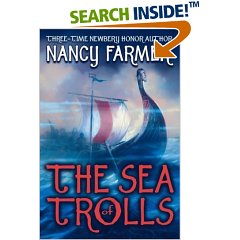
The Sea of Trolls


The Sea of Trolls by Nancy Farmer. Read by Gerard Doyle. (Recorded Books)

Well, howdy, blog fans! This is the third in a series of reviews of children's and young adult audiobooks I've listened to recently that I wanted to share with you.

The Sea of Trolls has much to recommend it. It draws heavily on Norse mythology, an Anglo-Saxon epic, and even a famous nursery rhyme to create an exciting fantasy full of action and adventure, memorable characters, fantastic creatures, and exotic landscapes. This otherwise excellent novel for young people, however, is marred by what seems to be the author's philosophical or theological agenda and some rather heavy-handed editorializing. Christianity and the old pre-Christian religions of Europe are constantly compared, and Christianity nearly always seems to come up short.

In a small coastal village in early medieval England there lives a young boy named Jack. The most exciting events in his everyday life are tending sheep, mucking out the barn, and feeling vaguely jealous of his, pampered younger sister Lucy. All that changes one day when the local poet, wise man, and shaman, known simply as "The Bard," recruits Jack to be his apprentice. The Bard begins teaching Jack the ancient lore of bird and beast, flower and field, tree and leaf, river and ocean. In a clever twist, author Farmer imagines that The Bard is the author of the great Anglo-Saxon epic Beowulf, and thereby hangs the plot. The poem tells the story of how the great warrior Beowulf defeated first the monster Grendel and then Grendel's mother, only to be defeated himself many years later by a terrible dragon.

In Farmer's imaginative departure from this tale, it seems Grendel's mother had a sister, the half-human, half-troll princess Frith, and she's still plenty ticked at The Bard for participating in her sister's downfall. Every night she sends out her spirit, a ghastly malevolent phantom, on a night-mare (literally a monstrous eight-legged horse) to destroy The Bard. When that fails, she sends out a fierce band of Vikings under the command of Olaf One-Brow (so named because his bushy blond eyebrows seem to flow continuously over both eyes) to raid Jack's village. Jack and Lucy are captured by Olaf's men, and The Bard, for some strange reason, is reduced to a babbling idiot, seemingly incapable of coming to Jack's aid. An unusually intelligent crow that Jack names Bold Heart appears out of the fog at a crucial moment, however, to accompany Jack and Lucy on their journey.

Jack and Lucy seem destined for a life of cruel slavery, taunted by Thorgil, the "shield-maiden" or female ward of Olaf, who is just a little older than Jack. When Olaf and his men learn Jack has some skill as a wizard and poet, or skald, however, they treat him with more respect and even a trace of fear. Over time, Jack comes to develop a grudging respect for the Northmen and even the tentative beginnings of a friendship with Olaf. After a long sea voyage, Jack and Lucy arrive in the land of Queen Frith and her husband Ivar the Boneless (so named because of his morbid obesity and his utter inability to stand up to his shrewish wife).

When a bit of Jack's poetry in praise of Frith's hair magically and accidentally makes her hair fall out, the queen is outraged. She commands Jack, Thorgil, and Olaf to go on a quest to Jotunheim, or the land of the trolls, in search of water from Mimir's Well. Water from the well will give Jack the knowledge he needs to restore Frith's hair. If Jack and his companions do not return from the quest before the specified deadline, Lucy will be sacrificed to the goddess Freya. If they return in time, Frith will allow Jack and Lucy to go free.

Jack, Thorgil, and Olaf find Jotunheim, but the trolls and other magical creatures in it are not what they expect. Olaf sacrifices his life on the quest, and Jack and Thorgil must each sacrifice something of great importance to gain water from the well. Along the way, Jack learns Thorgil too, was once a slave, and that her real name is Jill. This discovery, and the quest for water from the well, lead to the creation of a famous nursery rhyme (Can you guess which one?) Jack and Thorgil return from Jotunheim with the cure for Frith, but her own greed and arrogance prove her undoing. Olaf's son agrees to return Jack and Lucy to England, and upon his return, Jack even learns the reason for The Bard's strange illness and the true identity of Bold Heart the crow.

At the beginning of this review I mentioned how this otherwise excellent novel is marred by the author's apparent need to compare Christianity to the ancient pre-Christian religions of Europe (and, I suspect, their modern "New Age" or neo-pagan counterparts). Jack's dour father, the local monks, and other overtly Christian characters, are constantly making grim pronouncements about suffering and the will of God. Jack notices that The Bard does not piously cross himself and intone "Amen," when Jack's father makes one of these sententious statements in the way that Jack's family does. In private, The Bard will even exclaim such things as, "May Odin preserve me from such idiocy!" or, "Thank Freya, you're all right." The Bard is a follower of the old ways.

I might be able to take this with a large grain of salt (Coleridge's willing suspension of disbelief and all that), if it weren't for The Bard's inane prattle about "serving the Life Force" that sounds as if it came from a bad early draft of the script of Star Wars. (The Bard does indeed sound like some kind of medieval Obi-wan Kenobi, and as he ranted on and on during these monologues, I half expected him to whip out a lightsaber and announce dramatically, "Jack! I am your father!") When Jack and Thorgil find Mimir's Well, they also find Yggdrasil, the tree of life from Norse mythology. This is a kind of gigantic, earthbound Noah's Ark that shelters every creature on earth and every possible spiritual destination for those creatures--Asgard and Valhalla for Vikings, heaven for Christians, "and other places I don't even know about," Jack explains. It's cool. It's all life, right? Whatever.

For a Christian, there are so many problems with this line of reasoning I hardly know where to begin. In the first place, Christians are not expected to actively seek out suffering (Even Jesus before his crucifixion prayed, "Father, if it be your will, let this cup pass from me"), When (not if) suffering comes, however, Christians are expected to embrace it as the will of God as Christ did. (He also prayed, "Father, not my will, but yours be done"). Christ, however, did not embrace suffering merely for the sake of suffering, but because it was redemptive. Christ's sufferings accomplished his Father's plan of redemption from sin for the whole world. When followers of Christ suffer in imitation of their master, they are called to join their sufferings to the sufferings of Christ (Col. 1: 24) and participate in the work of their own redemption and the redemption of those around them. What Farmer implies, therefore, about the Christian position on suffering is almost a parody or caricature of the truth.

In the second place, for the Christian, life is not an abstract, impersonal "Force" that somehow exists apart from God to be served or worshipped. It is the result of concrete action by a loving and personal God who created all that is (Col. 1: 13-23). Jesus Christ came that we might have life and have it to the full (Jn. 10: 10) for the God of Christians is "not a God of the dead, but of the living" (Lk. 20: 38), and Christ's resurrection from the dead is conclusive proof of God's power over life and death (1 Cor. 15).

Despite all these Scripture references, I don't consider myself some kind of Bible-thumping Fundamentalist. I am, however, a Christian and a Catholic, and over the last year especially, I have struggled with these questions of suffering, life, death, and resurrection. It pains me to see the Christian position distorted in this way, and some kind of neo-pagan alternative peddled to kids under the guise of fiction. I suppose I can be grateful that Farmer didn't insert additional twaddle about "the sacred feminine" á la Dan Brown.

I am also not a Fundamentalist in the sense that I don't become apoplectic any time I see any reference to magic in fantasy fiction, out of some hysterical fear that it will promote the occult. I've read the Harry Potter books, Jeff Smith's comic book epic Bone, the Shannara books of Terry Brooks, and Robert Jordan's Wheel of Time series, all of which use magic with little or no reference to Christianity. I've also read Tolkien's Lord of the Rings and Lewis's Chronicles of Narnia, which are, of course, solidly Christian in their outlook and present Christian truth indirectly, symbolically, and allegorically through the conventions of fantasy. I've even read Katherine Langrish's juvenile novel Troll Fell, which like Farmer's, draws extensively on Norse mythology, but unlike Farmer, without reference to Christianity. Why Farmer felt motivated to engage in this "comparison shopping," or simple-minded relativism is beyond me, unless she has an axe to grind.

Bottom line: If you can overlook the pseudo-religious, pseudo-mystical piffle in this book, read it (or listen to it) and enjoy. If not, there are lots of better fantasy and adventure titles out there that don't have all the questionable baggage.
Sunday, May 14, 2006

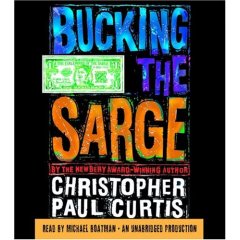
Bucking the Sarge


Bucking the Sarge by Christopher Paul Curtis. Read by Michael Boatman. (Listening Library)

This is the second in a series of audiobook reviews I want to share with you. This book is a witty and ironic look at life in contemporary black America that readers of all races can enjoy. For all the laughs, however, there's a serious message to this book. The message seems to be that a corrupt social and economic system--in many cases created and maintained by black people themselves--allows blacks to oppress and exploit other blacks and deny opportunity to all but the most creative and talented African Americans.

Fifteen-year-old Luther T. Farrell lives amid the urban, post-industrial decline of a predominantly black neighborhood in present day Flint, Michigan. Yet Luther is not the typical African-American teen. He is going for his third consecutive win in his middle school science fair, and his life's ambition is to be "America's Best-Known and Best-Loved Philosopher." Embarrassed by a grade school incident in which he mispronounced the name of Socrates, Luther always precedes his borrowed pearls of wisdom with, "A well-known philosopher--whose name escapes me at the moment--once said . . ."

The only obstacle to victory in the science fair is Shayla "I See Dead People" Patrick, the daughter of Flint's most prosperous African-American undertaker, also a straight A student, and the woman Luther has both loved and hated since they were both four years old. In true Tracy-Hepburn fashion, Luther and Shayla are crazy about each other, but dare not admit it, and can't be in the same room together without sparks flying. Luther carries an unused condom in his wallet in case romance should break out, but it looks as though the condom (named Chauncey because it's come to seem like an old friend) will languish in obscurity.

The only obstacle to Luther going on to college and truly starting his philosophical career is his mother--aka "The Sarge." She's a cold, calculating, avaricious woman, who through iron will and ruthless determination has risen from factory worker to school teacher to slum lord, running loan shark rackets, substandard housing projects, and group homes all over the city. She's bilking the system for all it's worth, charging the government for the cost of steak and shrimp, being reimbursed, buying the cheapest food possible for the group homes, and pocketing the difference. Luther has been the "manager" of one of these group homes since he was thirteen, and the Sarge has no intention of releasing him from servitude.

When Luther realizes that his science project--a report on the illegal use of lead-based paint in low-income housing in Flint--has the potential to bring about his mother's downfall, he feels both regret and fear. Regret because The Sarge is, after all, his mother. Fear because The Sarge is, after all, The Sarge. She's not going to be happy that her own son has blown the whistle on her and destroyed her profitable little empire. When Luther discovers that The Sarge has been siphoning off money intended for his college fund, however, he decides to take action and creates his own unique plan for revenge.

Does the Sarge get what's coming to her? Does Luther admit his true feelings to Shayla and vice versa? Does Chauncey see some action? You'll have to read the book. The author's rather blasé attitude about teen sex, and Luther's desire for revenge against his own mother may seem morally problematic to some listeners, but let's face it--they're realistic. What teenager doesn't think about sex, and with today's oversexed, "just use protection" culture, it's easier than ever to turn teen fantasy into reality. And the Sarge is a witch, after all. She's a corrupt authority figure, and the human sense of justice naturally wants to see corrupt authority brought down.

This story is told with so much humor and with tongue so thoroughly in cheek that it's hard to be truly offended by some morally questionable attitudes. There are memorable minor characters such as Luther's best friend Sparky, Marcel the fence and his pit bull Poofy, the shyster lawyer Dante Orlando Gatty (call 1-800-SUE-EM-ALL), and Darnell Dixon, "one of Flint's leading psychopaths." This book makes you laugh and think, and parents and teens may even want to talk about it after listening. Recommended.

Saturday, May 13, 2006

Feed


Feed by M. T. Anderson. Read by David Aaron Baker. (Listening Library)

This is the first in a series of audiobook reviews I wanted to share. In this young adult novel, Anderson presents a devastating satire and cautionary tale about what could happen when the worst tendencies of today's empty-headed, entertainment-obsessed consumerist popular culture are merged with the worst passive, mind numbing, dumbed-down tendencies of emerging information technologies. Titus and his friends, teens of the not-too-distant future, have lived their entire lives with the hardware and software needed to access the next generation of the internet--known simply as "The Feed"--wired directly into their brains. "Everything that happens, happens on the Feed," Titus says.

Feed subscribers are bombarded with a constant stream of images, sounds, and slogans, all promising them one entertainment experience after another, each more fabulous than the last, and all carefully crafted to persuade them to be avid and mindless consumers. The Feed is the first thing they wake up to in the morning and the last thing they hear before going to sleep at night. Entertainment is even more vacuous than it is today (The most popular "feedcast" is a reality show called "Oh. Wow. Thing."), and information, such as it is, is delivered without depth or context. The Feed can be customized for each individual subscriber, isolating individuals from each other in their own computer-generated worlds. Schools, which exist principally for the purpose of creating not-so-smart shoppers, are run by corporations that can replace live teachers with holograms as a cost-cutting measure.

Using the Feed's computer networks, Titus and his friends can have access to practically any piece of information, but this very ease of access and the flood of information at their virtual fingertips has made them hopelessly intellectually lazy. Slang, slogans, and swear words have taken the place of intelligent discourse, and very nearly, of rational thought. Titus and his friends can barely finish a sentence without resorting to a four-letter word of some kind. Some listeners will find this constant profanity offensive, but I believe this is part of the book's overall message and not merely inserted for shock value. Titus and his friends are so intellectually and spiritually blighted by The Feed that they lack the mental and verbal vocabulary to express themselves without resorting to vulgarity."Everyone's super smart now," Titus says, without a trace of irony.

The Feed's omnipresence has blinded Titus and his friends to the collapse of the world around them. His elders can remember when the last forests died and wild animals took refuge in the cities. The landscape is covered with high rises and shopping malls, each with its own artificial environment. Even furniture is disposable. The air is so polluted that green rain falls from black clouds. Children are created artificially in "conceptionariums," and filet mignon is grown on farms where Titus and his girlfriend can wander surrounded by grotesque mazes of meat. Feed subscribers have begun to develop strange hideous lesions and skin diseases, but with a little careful manipulation from the Feed, the lesions can be presented as the latest fashion accessory. Titus and his friends are dimly aware of the emptiness of their lives, but they have been left so intellectually and spiritually stunted by the Feed that they can scarcely conceive of an alternative.

While on vacation with his friends on the moon, which has become a combination tourist trap and garbage dump, Titus meets Violet, a girl different from anyone he has ever encountered. She has been home schooled, can actually write using pen and paper, wears clothes made of wool rather than plastic, and did not have the Feed installed in her brain until she was seven years old. She resists and confounds The Feed by asking about the most bizarre and unrelated consumer products she can imagine and then not buying any of them, thus preventing The Feed's computers from profiling and categorizing her. A romance between Titus and Violet begins but is not to last. Titus and his friends are attacked by a hacker, forcing them to be temporarily disconnected from the Feed. In most cases this leads only to a few days of anxiety and disorientation, but because Violet had her Feed installed much later in life, the consequences are more severe. Over time, her Feed hardware and software malfunction more and more severely, until finally it becomes clear she will die. Violet's death forces Titus to emerge from his shell of self-absorption and self-indulgence and take up her resistance to The Feed. The last words of the book, the advertising slogan, "Everything must go!" take on a whole new meaning now that Titus has seen the Feed for what it truly is.

The book mirrors perfectly the disgust and revulsion I've come to feel with much of pop culture today, the feelings that led me to give up TV for Lent. I see many of the same feelings expressed by the Catholic bloggers and commentators I read. I don't know M. T. Anderson's religious views, if any, but I suspect he is a secularist, since he doesn't seem to offer any kind of spiritual solution to the soul-killing emptiness of his world. Yet it does seem to me that when both religious and secular critics are pointing out the emptiness and sickness of much of our culture, you know we've got a problem. This outstanding book is a searing indictment of some of the worst aspects of today's society that technology-savvy mall rats and their parents should read before the grim prophecies of this book come true. As Titus might say, "Unit! Feed is like . . . meg brag!"