I was dismayed to learn recently that the very popular and entertaining, yet thoroughly orthodox Catholic Ragemonkey blog is no more. The blog's authors, Father Shane Tharp and Father Stephen Hamilton have decided that their priestly ministries were too demanding to allow enough time for regular blog entries and that their priestly work should always be their first priority. Like many of their regular readers, I am saddened by their joint decision, but I understand it completely and respect and commend their dedication to serving the Body of Christ.
That's the bad news. The good news is, one of my favorite blogs is back, one of my other favorites has a new name, and I've recently found several wonderful new additions to the blogroll. After a protracted hiatus, Rod Bennett of Tremendous Trifles is back to blogging on a regular basis. He took a break from blogging to complete a screenplay for a Christian-themed science fiction film called The Christus Experiment (a project about which I am mightily curious, BTW). Rod has a fascinating way of reflecting on the ways in which Christian themes are or are not reflected in popular entertainment, especially science fiction, fantasy, and adventure fiction. Lately, Rod has been serializing his own screenplay for a King Kong remake. Do check it out. Also, my pal Mark Mossa, S.J., has retitled his blog from "You Duped Me, Lord," to "And I Let Myself Be Duped."
In other news, the blogroll here at IAS has taken on a bit of an international flavor with the addition of auntie joanna writes by British blogger Joanna Bogle and Purcell's Chicken Voluntary by Australian blogger Louise. Both ladies write with style, wit, and uncommon common sense about the nonsense that goes on in our world when we try to ignore the truth of Christ. And as long as I'm writing about bloggers outside the good ol' U S of A, how could I forget the ever-trenchant Kathy Shaidle at Relapsed Catholic up in Toronto?
Over on this side of the pond, I've recently discovered Heirs in Hope by blogger Drusilla in which she reflects deeply on the mystery of suffering in the Christian life and the necessity of uniting our sufferings with those of Christ. I believe she has some long-term chronic health problems, as I do, so this is not a question of merely academic interest for either one of us.
Finally, I've discovered two Catholic podcasting blogs, Maria Lectrix hosted by blogger Maureen, and Pavel Reads, hosted by poet and blogger Pavel Chichikov. Maria Lectrix is an eclectic mix of readings from public domain texts ranging from poetry, history, mystery, fantasy, and science fiction, to Christian classics and the writings of the Church Fathers. For Pavel Reads, poet Pavel Chichikov reads his own poetry on sacred and secular subjects. Appropriately for Lent, he has offered a set of poems on the Sorrowful Mysteries of the Rosary, and is working his way through another cycle on the Stations of the Cross.
I myself promise to be a more faithful blogger in the future. Until next time, friends.
Saturday, March 17, 2007


To Blog or Not to Blog: A Bleg

Top of the mornin' and a happy St. Patrick's Day to all three of my regular readers! I have a bleg (blog question--perhaps the word is derived from a combination of "blog" and "beg"?) for you. As may have noticed, this blog has been silent for some time. Things have been happening around here lately, but not the kinds of things I'm completely comfortable sharing with the entire blogosphere--important decisions about my future and such. It made me wonder if I should get out a notebook I sometimes use for a private journal and thrash out the issues in there. My question, or bleg, is this: Do you, my fellow bloggers, also keep a private journal for writing about stuff you would rather keep confidential? How much of yourself do you feel comfortable revealing on your blog? Do you only blog about public matters and keep the rest private, or do you let it all hang out? Just wondering.
Saturday, February 10, 2007
Just A Writin' Fool

I pulled an all-nighter writing last night, and I don't regret it a bit. Well, OK, maybe a little—but only because I'm tired today. But I felt so alive last night, more than I have in months. Purely for entertainment purposes, I'm working on a story in which The Shadow meets Superman and am having a blast writing it. Obviously, with a theme like that, the story takes its inspiration from the pulp fiction, old radio, and classic comics of the 1930s and '40s that I love so much. The narrative device that allows the two heroes to cross over and interact in each other's worlds is so amazingly simple, I'm surprised nobody thought of it before. Can you guess what it is? I'm not telling. :-)
 Yesterday I got inspired and added a scene that I think ramps up the action, rewrote some others, and started thinking about how the finished story might look once I put it up on my website. Astounding Adventures is an online archive for my fiction writing, modeled on and inspired by the old pulp magazines of the '30s and '40s. When will the story be finished? Only the Shadow knows. But I know I'm having fun, and I've come too far to quit now. Shadows of Steel is coming soon to a Web browser near you.
Sunday, February 04, 2007
Insights
I want to apologize to my regular readers (all three of you) for not posting for a while. I'd rather not go into all the reasons why, but suffice it to say I was deeply depressed, feeling regretful over the past and fearful over the future—which left me feeling pretty much stuck and lousy in the present. I sent an e-mail to the incomparable Dawn Eden, thinking that she might have some insights into my situation. She writes perceptively about the problems of us thirtysomething and fortysomething Catholic single folk, and has frequently mentioned that her conversion to Christianity has helped her overcome depression. She asked some very simple questions, and in the course of praying over the situation, listening to the readings at Mass this morning, and responding to Dawn, I received some insights that may be helpful to others in similar situations. As I wrote to Dawn:
Here I asked Dawn to continue to pray for me and I make this request of all my readers as well: Please pray that God will grant me the courage to take the many steps necessary to make this big change. Truth be told, I hate change, but in this case I think big changes are needed.
Last night as I was praying through the First Joyful Mystery of the Rosary, the Annunciation, (Lk. 1:26-38) I received an important insight. Mary had no idea how she could be the mother of the Son of God if she had never had relations with a man. Even once the angel explained it to her, I doubt she fully understood. Who could fully comprehend such a marvelous thing? She did not say, "What do I HAVE TO DO to make this happen?" She said, "You see before you the handmaid of the Lord. Let it be done to me according to your word." She understood that it was not by her own effort that the awesome purposes of God would be worked out; but she trusted that GOD'S power and purposes would be accomplished THROUGH HER if she made herself a willing instrument. That is why she said later, "Henceforth all generations will call me blessed. For the Almighty has done great things for me." She trusted that if God had said a thing would be accomplished in her life, it would be accomplished—and it was—but in a way far different from and far greater than anyone expected.
All the readings at Mass today reinforced this theme. Isaiah, Paul, and Peter were all acutely aware of their sinfulness and their utter inadequacy to stand before God on their own merits. Yet God called them, prepared them, and purified them, and they accepted the call. It's also important to note that they had ABSOLUTELY NO IDEA of what would happen to them once they accepted the call, but they accepted it anyway,
For some time now, I've been struggling with feelings of failure and worthlessness, as if everything I tried to accomplish by my own efforts—my work life, my spiritual life, my personal relationships—has been a complete bust. I kept asking God, "What do I need to do?" as if God's purpose could be accomplished my effort alone. I kept asking him "Where do I need to go?" as if I needed a complete itinerary before I took a single step. I need to remember the huge difference between trying to do everything by my own effort and allowing myself to be an instrument of God's purposes. I also need to remember that I will never fully understand God's plans and purposes for me—and that's OK! We are all called to follow Christ, but we don't need a complete road map of every possible stop before we set out on the journey. All that matters is the ultimate destination—Heaven.
This new insight does not completely solve all my problems, but it does give me a valuable new perspective and a way forward out of the swamp. In a strange way, it confirms my growing conviction that I need to relocate. My family has wanted me to move to Charlotte, NC, where a brother and sister are living, ever since Dad died. I resisted, mostly out of refusal to let go of the past and fear of the future. In Charlotte, I will have more opportunities for a better job, better opportunities for rewarding relationships, better health care, better psychological care, and better opportunities for spiritual direction.
Here I asked Dawn to continue to pray for me and I make this request of all my readers as well: Please pray that God will grant me the courage to take the many steps necessary to make this big change. Truth be told, I hate change, but in this case I think big changes are needed.
Monday, January 08, 2007
Smashing, Eh What?
 | My Peculiar Aristocratic Title is: Milord Sir Lord Neil the Fiendish of Chalmondley St Peasoup Get your Peculiar Aristocratic Title Hat Tip: Catholic Ragemonkey. |
Saturday, January 06, 2007
Panda-monium!

"Good evening Mr.and Mrs. Blogreader and all the ships at sea! Welcome to another thrilling episode of . . . It's All Straw!" (Cue dramatic organ music).
Two of my great pleasures in life are listening to classic old radio and surfing the Net. These two loves come together in a real doozy of a website that I found recently: Decoder Ring Theatre and its flagship podcast, The Red Panda Adventures, created by Gregg Taylor and a talented troupe of Toronto-based thespians. Obviously inspired by classic radio shows of yesteryear such as The Green Hornet and The Shadow, The Red Panda Adventures are witty and stylish revivals of the old costumed crime fighter melodramas. The Red Panda and his trusty sidekick and chauffeur Kit Baxter, also known as The Flying Squirrel, guard Depression-era Toronto against a host of mobsters, monsters, and malefactors by using everything from radio rings and static shoes to powers of hypnosis and the
 occasional sweet left hook. As written by the very talented Gregg Taylor, the shows are just sly enough not to be in deadly earnest and just serious enough not to slide into outright parody. The Red Panda rocks! New episodes are promised in March.
DRT's other regular offering at present is Black Jack Justice, a hardboiled private eye show in the tradition of Sam Spade and Philip Marlowe. Shows like this were legion in the later years of old radio, the late 1940s and early 1950s. The very latest episode of Black Jack Justice, "The Purloined Format Caper" is in fact a tribute to the radio version of The Adventures of Sam Spade. In BJJ, Jack Justice, a World War II veteran and down at the heels gumshoe, and his partner, "Trixie Dixon, Girl Detective" prowl the mean streets, hearing the million stories in the naked city, hounded and occasionally helped by their nemesis, Lt. Sabian of Homicide. As with the Red Panda shows, BJJ is very well written with sharp, clever, banter between the male and female leads and plenty of two-fisted action. However, in keeping with their Hammett, Chandler, and film noir antecedents, the tone of the Jack Justice stories tends to be a good bit darker and less cheery than the Panda shows, but never completely grim or family unfriendly. This too is in keeping with the originals. The radio versions of Spade and Marlowe were considerably lightened up for the listening audience. New episodes of Black Jack Justice will be appearing on Saturdays over the next several weeks.
By the way, lest you think that a female private eye in the '50s is just some 21st century feminist revisionism, NBC radio did in fact run Candy Matson on its West Coast stations from 1949-1951. Candy was a lady shamus based in San Francisco. While not as hard hitting or hard drinking as her brethren, Candy could crack wise and crack cases with the best of 'em. I've found a couple of episodes of Candy Matson through the internet, and actress Natalie Masters (whose husband Monte was also the show's writer and producer) gave Candy a voice that was equal parts steel and sex appeal—a woman ahead of her time.
(Cue organ music). And so, blogreaders we come to the end of another thrilling episode of It's All Straw. Be with us next time, when you'll hear Niall say:
What the heck am I gonna write about now?
Friday, December 29, 2006
From the IAS Sports Department . . .

This just in from the Sports Department here at It's All Straw:
University of South Carolina 44
University of Houston 36
Get details here!
Meanwhile . . .
University of Kentucky 28
Clemson University 20
Get details here!
Tough break, Creegs!
Saturday, December 16, 2006
Claybourne: The Season That Never Was

In my previous post, I discussed the original radio and podcast drama Claybourne. Here are some further thoughts.
One of Claybourne's creators, Andrew Dubber, keeps a blog and in this post he explains that the 96 extant episodes of Claybourne were only the first half of a planned two-season story arc for the show. Regrettably, the money ran out, and the second season was never made. He provides a synopsis of the show for those who haven't heard it and a brief outline of the phantom second season, a tantalizing glimpse of what might have been.
He proposes many ideas I like and some I don't. In Season Two, we would have learned more about the origin and intentions of the taniwha (If you think the story is weird now, just wait. It gets weirder). The odious Frank Buchanan and his equally reptilian estranged son Philip reconcile to each other and find a measure of redemption as they sacrifice themselves to defeat the taniwha and save the town. Frank's proposed theme park, "Maoriworld," is never built. Clive Moody, a smooth talking computer expert addicted to creature comforts, goes mad and dumps all of his gadgets, from his espresso maker to his stereo system (perpetually playing cool jazz) out on his front lawn. So far, so good. Dubber's plans for Thompson and Karen, however, were positively perverse:
Karen's abusive husband finally turns up - only to be eaten by the taniwha... but not before threatening Karen with extreme violence. She ends up running away (after he threatens her, but before he gets eaten) and for some reason I can't entirely recall, she ends up in prison in Auckland.(Emphasis added).
You remember she took off with the money after Janine's death - well, most likely she was nabbed for passing counterfeit bills (though we toyed with the idea of credit card fraud). I don't think we ever finalised the details - but I know we wanted to subvert the lovers' happy ending at all costs.
Thompson takes her one phone call but dismisses it as another fraudulent Delilah trick. It was going to be cruel, surprising and very, very final. We just thought it was funny at the time and that seemed a good enough reason.
Thompson, of course, settles in Claybourne - probably, we thought, reunited with his wife (though she would have been fun to kill).
I, for one, would have been infuriated with this ending. Call me an old-fashioned romantic, a sentimentalist at heart, but I thought Thompson and Karen deserved a break. These characters have been kidnapped, shot at, and buried in concrete up to their necks, and now they're NOT going to get together? Aw, c'mon! That's not transgressive, just twisted. What's especially disturbing is the evident glee with which these plot developments were contemplated. Sounds to me like some especially nasty postmodern cynicism breaking through, as if to say, "All that old-fashioned stuff about love, and courage, and justice? It's all bullshit." Yes, "real" life is often painful, cruel, and unjust. That's why I think, at least occasionally, happy endings are important in fiction. A steady diet of defeat in both fact and fiction leads not to "realism" but to despair.
All is not lost, however. Dubber concludes his post with this sentence that's practically a license to re-imagine the story as the listener sees fit:
"Likewise, feel free to embellish the story in your own imagination. It's all yours now."
I think I feel the urge for some Claybourne fan fiction coming on :-).
"Claybourne"

What do artificial intelligence experiments, strange legends of New Zealand's Maori people, corporate hit men, and morphine-addicted real estate developers have in common?
They're all elements of Claybourne, an original radio drama broadcast in New Zealand in the 1990s and now resurrected on The Podcast Network. I've previously blogged about how much I've come to enjoy podcasts in general and podcast dramas in particular, and Claybourne is definitely one of the most original, entertaining, and at times, downright bizarre podcast dramas I've come across--despite a few flaws I'll get to in a minute. This story should appeal to fans of The X-Files, Lost, and Heroes, and with the latter two shows on hiatus until after the first of the year, Claybourne might serve as a substitute for those seeking entertainment that's chock full of paranormally weird goodness.
While on vacation in New Zealand, Thompson, an employee of an American telecommunications firm, is summoned to the remote village of Claybourne, where one of his company's transmitting and receiving stations seems to be malfunctioning. From the moment he arrives, strange things start to happen. His cell phone goes dead and none of his faxes to the home office go through. The local Maori shaman warns of a terrifying dragon-like creature lurking outside the village at night--a creature Thompson seems destined to confront. The manager of the station turns up dead under very suspicious circumstances, and the local constable seems only too happy to sweep the whole matter under the rug. The local landlord, a brash arrogant entrepreneur named Frank Buchanan, confronts Thompson with a gun. Everyone in town seems to have a secret, but no one seems to want Thompson to leave. Romantic sparks fly between Thompson and Karen the hotel manager, but even she has a troubled past. The deeper he digs into the mystery the weirder it gets.
The dead station manager was an expert in behavioral psychology, and the manager before that, who mysteriously disappeared, was a disgraced former military officer. For some reason, the station is equipped with an elaborate state of the art security system, far more sophisticated than anything a telephone company would need. The company is willing to pay any price, including a million dollars in cash to a local landowner, to keep the station running. People in town are receiving unexplained phone calls and faxes. Just what is going on up there? It seems Thompson's company and the U. S. government have been conducting experiments in artificial intelligence using the station as a laborotory and the people of the town as guinea pigs. Things have gotten way out of hand, and the company has sent in Thompson, and later, a thuggish expert in "risk management" to clean up the mess.
Claybourne is part whodunit, part sci-fi thriller, part travelogue, and part soap opera, but it's all entertaining and all delivered with a distinctive Kiwi accent. The contrast and sometimes tension between the dominant white or European culture and the distinctly different native Maori subculture provides an important subplot and adds color and texture to the story. The two flaws I mentioned have to do with the length of the episodes and a maddeningly inconclusive end to the series. The episodes are short, averaging less than seven minutes each. This means that just about the time the story takes an interesting or provocative turn, the listener has to stop and download the next episode. The alternative, of course, is to download several episodes at a time, but this can be time-consuming, specially for listeners like me with a dial-up connection.
The other weakness to the show is a maddeningly inconclusive end to the series. Just as it seems our hero and heroine, Thompson and Karen, can safely declare their love for one another, Thompson's ex-wife Monica, for whom he's still carrying a torch, arrives on the scene. Will Thompson and Monica reconcile? If so, where does that leave Karen? The series ends as she decides to leave Claybourne with Mike, a young Maori man who had been Thompson's ally, and with the million dollars Thompson's company provided, unaware that the money is counterfeit. Meanwhile, up at the station, in a truly bizarre twist, "Delilah," the artificial intelligence behind much of the mischief in Claybourne, and the strange dragon-like entity known as the taniwha enter into an unholy alliance.
More on Claybourne in my next post.
Another Satisfied Customer
In response to my recent post concerning the University of South Carolina's victory over Clemson, blogger Creegs wrote:
Thanks, Creegs! I'm not sure I like the "bitter hatred towards just about all Cock fans" part, but I appreciate your compliments on my writing, and I think it's very generous of you to wish us luck in the upcoming Liberty Bowl.
See Creegs? USC fans aren't all bad--as long as you get us back in our coffins before the sun comes up :-).
I am a Clemson alum, and fan. That game ripped my heart out. I have nothing but bitter hatred towards just about all Cock fans, but I must tell you, your writing and tale of the story was very entertaining, and appreciated. Good luck in the bowl game!
Thanks, Creegs! I'm not sure I like the "bitter hatred towards just about all Cock fans" part, but I appreciate your compliments on my writing, and I think it's very generous of you to wish us luck in the upcoming Liberty Bowl.
See Creegs? USC fans aren't all bad--as long as you get us back in our coffins before the sun comes up :-).
Saturday, December 02, 2006
Toora, Loora, Loora To You Too!
Are there closet Catholics on the staff at Trinity Broadcasting Network?
I was pleasantly surprised while channel surfing late last night to find the mostly Protestant-oriented cable channel showing Going My Way starring Bing Crosby and Barry Fitzgerald. They've also recently shown The Shoes of the Fisherman with Anthony Quinn, reruns of Bishop Sheen's old Life Is Worth Living series, and admiring documentaries about Mother Teresa and Pope John Paul II. These forays into Catholicism are welcome diversions from TBN's usual parade of evangelical preachers marching back and forth across the giant stages of megachurches, badgering, lecturing, and hectoring their congregations while waving oversized Bibles at them. When I'm visiting kinfolk in Charlotte, I can watch EWTN on cable up there, but this part of South Carolina may as well be the buckle on the Bible belt. I'm glad to see that TBN at least acknowledges that Catholics are Christians. I'd love to see more Catholic-oriented programming from TBN: more Catholic movies and maybe even (gasp!) a televised Mass occasionally. Hey, it could happen!
As for the movie Going My Way itself, by today's standards, it's a schmaltzy piece of work (even one of the characters uses that word to describe the title song), but it is refreshing to see priests portrayed positively--nary a closet homosexual, a pedophile, an authoritarian prig, or an alcoholic in the bunch. Unlike, say, the hatchet-job Priest, in which all these loathsome stereotypes appear. Heck, in Going My Way, priests even look like fun people! Sure, Barry Fitzgerald plays a crusty old Irish padre, but even he turns out to have a heart of gold. Bing Crosby plays the young, progressive Father O' Malley, sent in to cash-strapped St. Dominic's parish to replace Father Fitzgibbon (Fitzgerald), but instructed to do it gently in order to spare the older priest's feelings. Der Bingle organizes the local street punks into a boys' choir that sings pop tunes as well as liturgical music. Hearing "Would You Like to Swing on A Star?" juxtaposed with "Ave Verum Corpus" is a bit jarring to say the least, but hey, this is the gospel according to Hollywood. Father Bing, aided by his boys' choir and a former girlfriend who's now with the Metropolitan Opera, tries unsuccessfully to peddle the song he's written, "Going My Way" to a music publisher, in hopes that the fees and royalties will help St. Dominic's out of its financial woes. The publishers don't go for "Going My Way," but they do like "Would You Like to Swing on a Star," so Father Bing can get St. Dom's out of the hole. Father Bing and Father Barry develop a friendship, the church burns down, and Father Bing brings Father Barry's Mom over from Ireland, but Father Bing leaves St. Dominic's with a song in his heart because he knows he'll be replaced by his old high school buddy who's also become a priest.
This movie is a muddle, but it's a sweet, sentimental muddle, and I'll take sweet and sentimental over cynical and mean-spirited any day.
GAME! . . . COCKS! . . . GAME! . . . COCKS!

It occurs to me that I have been remiss in my blogging duties. I reported on Auburn's fifth consecutive triumph over their perennial foes Alabama, but I failed to announce the victory of my own beloved South Carolina Gamecocks over their detested arch rivals, the Clemson Tigers, by a score of 31-28. Better late than never. The title of this post is an effort to reproduce in print a neat little auditory effect you'll hear at home games. One side of the stadium yells "GAME!" The other yells "COCKS!" The stereophonic effect has been known to discombobulate opposing teams.
It wasn't just a game, it was a cardiovascular workout, with highs and lows and plenty of heart-stopping moments for fans. Too often, the Gamecocks come out looking like college football's equivalent of the Chicago Cubs, a bunch of lovable losers that you just can't help cheering for no matter how often they break your heart. Carolina fans celebrate every victory they can get, especially over Clemson. If there's one thing I've learned in nearly 40 years of pulling for South Carolina, it's to keep your expectations low. For example, right before half time, Carolina, down 14-7, was driving on the Clemson goal. USC quarterback Blake Mitchell dropped back to pass, but a Clemson defender got in his face, deflected the ball, and ran the other way for a Clemson touchdown. I thought we were doomed.
At one point in the third quarter Carolina trailed 28-14. Again, I thought we were doomed, but miracle of miracles, the Gamecocks rallied, using stiff defense and taking advantage of Clemson turnovers to actually go ahead 31-28 late in the game. Clemson, of course, promptly got the ball and drove down the field, lining up for a field goal that would have tied the game and sent it into overtime, where in all likelihood Clemson would win. Would Carolina's miracle slip away? I'd seen it happen before.
On the last play of the game, Clemson lined up for a field goal . . . and missed! Carolina beat Clemson! Could life get any sweeter? As a result of this titanic victory, the Gamecocks will now have the opportunity to play in the Totally Meaningless Media Event & Marketing Opportunity Bowl, or some such. Not so many years ago, there were only a few major college bowl games--Rose, Cotton, Sugar, Orange--and each one had a share in determining college football's national championship. In short, they meant something. Now, however, there are so many of these postseason extravaganzas that just about any team that wins more than half its games can go to one of these artificial hoopty-dos. Oh, well. We'll take it.
As an interesting side note, Auburn, whom I love for Dad's sake, and Clemson, whom I detest . . . well, just because they're Clemson :)--have many similarities. Both are the land grant colleges and agricultural and mechanical schools for their respective states. Both claim the Tigers as their mascots (
[UPDATE, 2009: Since this was originally posted, I have learned that there are many possible explanations for the origin of the phrase "War Eagle!" none of which can be verified].
Both schools use orange as one of their team colors. (Auburn uses orange and blue, Clemson, orange and white). But you see, because my Dad went to Auburn, Auburn Tigers are fine, hardworking, upstanding, God-fearing sons and daughters of the soil who labor diligently by the sweat of their brows to make the world a better place. Because nearly everybody else in my family went to Carolina (one of my sisters pulls for Clemson just to be contrary, but we love her anyway), Clemson Tigers are backward, ignorant, uncouth, unlettered rednecks and the source of all evil in the world :-). (JUST KIDDING!) :-)
In conclusion, I'd like to recall the words of our late beloved Pope John Paul II when he visited the USC campus several years ago. The Holy Father was addressing a group of students on the Horseshoe, the historic heart of the campus, when he departed from his prepared text and said:
"It is wonderful to be young."
(This was greeted with a scattering of applause).
"It is wonderful to be young and a student at a university."
(More applause)
"It is wonderful to be young and a student at the University of South Carolina."
(THUNDEROUS APPLAUSE).
I've always figured this was a dignified way for the Servant of the Servants of God, the Vicar of Christ, the Successor of Peter, the Supreme Pontiff of the Universal Church to say:
GO COCKS!
Saturday, November 18, 2006
WAAAAAAAR EAGLE!

This just in:
Auburn 22
Alabama 15
The Auburn Tigers have just defeated their archrivals, the Alabama Crimson Tide, for the fifth year in a row, by a score of 22-15. That's the first time that's happened since the 1950s. My Dad and a former college roommate of mine, who were both Auburn alumni, would be proud. Dad, Paul, this one's for you.
Sunday, November 05, 2006
Two by Hopkins

This time of year always makes me a bit melancholy, as it does many people, so I thought it appropriate to post this poem by the great English Jesuit poet and priest Gerard Manley Hopkins:
Spring and Fall
to a young child
MÁRGARÉT, áre you gríeving
Over Goldengrove unleaving?
Leáves, líke the things of man, you
With your fresh thoughts care for, can you?
Áh! ás the heart grows older
It will come to such sights colder
By and by, nor spare a sigh
Though worlds of wanwood leafmeal lie;
And yet you wíll weep and know why.
Now no matter, child, the name:
Sórrow’s spríngs áre the same.
Nor mouth had, no nor mind, expressed
What heart heard of, ghost guessed:
It ís the blight man was born for,
It is Margaret you mourn for.
However, I can't think of Hopkins very long without also thinking of this marvelous, much more joyous poem:
God’s Grandeur
THE WORLD is charged with the grandeur of God.
It will flame out, like shining from shook foil;
It gathers to a greatness, like the ooze of oil
Crushed. Why do men then now not reck his rod?
Generations have trod, have trod, have trod;
And all is seared with trade; bleared, smeared with toil;
And wears man’s smudge and shares man’s smell: the soil
Is bare now, nor can foot feel, being shod.
And for all this, nature is never spent;
There lives the dearest freshness deep down things;
And though the last lights off the black West went
Oh, morning, at the brown brink eastward, springs—
Because the Holy Ghost over the bent
World broods with warm breast and with ah! bright wings.
Hat Tip: Bartleby.com.
Saturday, November 04, 2006
The Most Important Thing

"More than that, I even consider everything as a loss because of the supreme good of knowing Christ Jesus my Lord. For his sake I have accepted the loss of all things and I consider them so much rubbish, that I may gain Christ."
--Philippians 3:8 (New American Bible)
For several weeks now, I have been feeling a vague sense of depression, discouragement, unease, restlessness, and dissatisfaction and couldn't figure out why. Then it hit me. I had allowed my prayer life to atrophy because I had become far too concerned with TV shows, comics, podcasts, blogging, internet surfing, and fiction writing. All of those things, taken in moderation, are not in and of themselves sinful, but without Christ they are empty. They are like Twinkies or some other dessert: as an occasional treat they add sweetness and excitement to life, but a steady diet of sweets without the "solid food" or "meat" of Christ (1 Cor. 3:2) is sickening, unhealthy and unsatisfying. All those things without Christ are, as Paul says to the Philippians, "rubbish." The New Jerusalem Bible puts it a little more strongly, using the word "filth," and the old Douay-Rheims Bible puts it even more strongly still, using the word "dung." Dung! Poop. Feces. Excrement. Who wants that? Not me.
Since Thursday of this week, I've made sure to allow time for prayer and Scripture reading every day, and I can already feel a difference. May I keep it up, "staying awake for even one hour." (Mt. 26:40). I want to scale back my time in front of the TV. The time I spend surfing Catholic blogs and internet sites and listening to Catholic podcasts, as worthy as it may be, is really no substitute for actual time before Christ in prayer.
I want to re-evaluate my fiction writing, too. I believe I mentioned that I was working on a story in which Superman meets The Shadow, a tribute to the classic, cornball pulp fiction I love so much. I've always loved The Shadow as a character, but I do know that The Shadow's creator, Walter B. Gibson, was heavily involved in the occult. I don't want to do anything, even indirectly, that would promote such things. Is it all just harmless make-believe, or an opening for something more sinister? Am I worrying over nothing? I don't know.
Saint Michael the Archangel,
defend us in battle.
Be our protection against the wickedness and snares of the devil.
May God rebuke him, we humbly pray;
and do Thou, O Prince of the Heavenly Host -
by the Divine Power of God -
cast into hell, Satan and all the evil spirits,
who roam throughout the world seeking the ruin of souls.
Amen.
For the text of the Prayer to St. Michael, a Hat Tip to Our Lady's Warriors.
Saturday, October 28, 2006
Who Needs Mainstream Media?
Anybody who reads this blog knows I have a love/hate relationship with television and other forms of mass media. At times I'll get disgusted and denounce everything on TV as unadulterated trash that's destroying Western Civilization as we know it, and at others I'll find a show that will attract my interest, spark my imagination, connect with my inner geek, and get me watching faithfully, at least for a while: shows such as Wild, Wild West, Star Trek, The Rockford Files, The X-Files, Lost, and Heroes, for example. One of the fascinating things about the personal computer and internet revolution, however, is the way it gives ordinary people the ability to produce and distribute information, opinion, and entertainment in a way that bypasses the conventional major media outlets.
For example, blogs give almost anybody the ability to become an op-ed columnist without going to work for a magazine or newspaper. I suspect one reason blogs are so popular right now is that many people feel their political views (whether right, left, center, or none of the above) aren't being adequately represented in the mainstream media. Fan fiction or "fanfic" websites such as Trekiverse, The Sugar Quill, and Fanfiction.net give aspiring short story writers and novelists a way to create new adventures of their favorite fictional characters and distribute their work to a potential audience of millions without going through a major publishing house.
Now some fans are taking all of these emerging technologies one step further by making old radio and TV shows available in digital format, and, even better, producing their own online radio and television shows. Since I'm currently working on a story about The Shadow, one of the heroes of radio's golden age, I've revived my interest in old-time radio and discovered hundreds of old radio shows available through iTunes and individual fan sites. I've also discovered sites such as Pendant Audio where a group of mostly twenty and thirtysomethings with a taste for audio drama are creating new audio adventures in the spirit of the radio shows of old. So far, they've created serial radio adventures featuring Superman, Batman, Wonder Woman, James Bond, and Indiana Jones. They've also created Dixie Stenberg and the Brassy Battalion, a tribute to/parody of classic adventure serials such as Captain Midnight, and Star Trek: Defiant, an original adventure in Gene Roddenberry's universe.
Another talented and dedicated group of fans are those over at Star Trek: New Voyages (Hat Tip to Rod Bennett) who are actually creating new episodes of classic Star Trek and making them available for download in Windows Media Player format. The actors (who are also the producers, writers, and directors of these shows) have paid out of their own pockets for props and memorabilia from the original series and have done a remarkable job of recreating the look and feel of classic Trek. They've signed Gene Roddenberry Jr. as a producer for one episode, and several alumni from the original series have made guest appearances, either as new characters, or reprising their original roles.
The weak spot, unfortunately, in both these fan-created audio and video dramas, is the acting. The performances (Ahem. How can I put this delicately?) lack a certain polish and range from truly abysmal to pretty good, depending on the performer's skill and previous acting experience. It's hard to be too critical, however, of people who are obviously having the time of their lives creating these shows and not making a nickel in the process. This is a labor of love for all concerned. Besides, almost anything's better than another episode of Survivor.
For example, blogs give almost anybody the ability to become an op-ed columnist without going to work for a magazine or newspaper. I suspect one reason blogs are so popular right now is that many people feel their political views (whether right, left, center, or none of the above) aren't being adequately represented in the mainstream media. Fan fiction or "fanfic" websites such as Trekiverse, The Sugar Quill, and Fanfiction.net give aspiring short story writers and novelists a way to create new adventures of their favorite fictional characters and distribute their work to a potential audience of millions without going through a major publishing house.
Now some fans are taking all of these emerging technologies one step further by making old radio and TV shows available in digital format, and, even better, producing their own online radio and television shows. Since I'm currently working on a story about The Shadow, one of the heroes of radio's golden age, I've revived my interest in old-time radio and discovered hundreds of old radio shows available through iTunes and individual fan sites. I've also discovered sites such as Pendant Audio where a group of mostly twenty and thirtysomethings with a taste for audio drama are creating new audio adventures in the spirit of the radio shows of old. So far, they've created serial radio adventures featuring Superman, Batman, Wonder Woman, James Bond, and Indiana Jones. They've also created Dixie Stenberg and the Brassy Battalion, a tribute to/parody of classic adventure serials such as Captain Midnight, and Star Trek: Defiant, an original adventure in Gene Roddenberry's universe.
Another talented and dedicated group of fans are those over at Star Trek: New Voyages (Hat Tip to Rod Bennett) who are actually creating new episodes of classic Star Trek and making them available for download in Windows Media Player format. The actors (who are also the producers, writers, and directors of these shows) have paid out of their own pockets for props and memorabilia from the original series and have done a remarkable job of recreating the look and feel of classic Trek. They've signed Gene Roddenberry Jr. as a producer for one episode, and several alumni from the original series have made guest appearances, either as new characters, or reprising their original roles.
The weak spot, unfortunately, in both these fan-created audio and video dramas, is the acting. The performances (Ahem. How can I put this delicately?) lack a certain polish and range from truly abysmal to pretty good, depending on the performer's skill and previous acting experience. It's hard to be too critical, however, of people who are obviously having the time of their lives creating these shows and not making a nickel in the process. This is a labor of love for all concerned. Besides, almost anything's better than another episode of Survivor.
Sunday, October 15, 2006
Hooked on Heroes

While we're on the subject of TV, there's another show I've started watching that looks like it has the makings of an addiction: Heroes (Mondays, 9 PM ET, NBC). I was intrigued by the promos this summer, caught the first episode, and was almost immediately hooked. The show's tag line is "ordinary people discovering extraordinary abilities." Across the globe, a small group of people discover they're not like everybody else—no matter how much they might want to be. It seems each of them has a genetic mutation that gives them superhuman traits:
In New York, a struggling artist and comic book writer, Isaac Mendez, has the ability to predict the future in his paintings. His girlfriend Simone wants to put him in drug rehab again, believing this is just some sort of delusion. She finds herself falling for the handsome young male nurse who is caring for her dying father. The nurse, Peter Petrelli, who is likewise falling for Simone, finds he can fly. The problem? So can Peter's domineering, politically ambitious older brother Nathan who wants something this bizarre hushed up.
In Texas, high school cheerleader Claire Bennett finds she is virtually indestructible. She has a friend videotape her repeated dives off a roof from which she comes up unscathed. She plunges into the heart of a fire to rescue an injured man and emerges without a scratch. She sticks her hand down a working garbage disposal to retrieve her class ring, and her bloody mangled hand reverts to normal in seconds. A fellow student leaves her for dead after a rape attempt and Claire awakens during her own autopsy. As if that weren't bad enough, her adoptive father, a nerdy looking guy with horn-rimmed glasses, is hunting down mutants and has found the videotape.
In Las Vegas, Niki Sanders, struggling single mom and webcam stripper, heavily in debt to the mob, discovers she has a really nasty—maybe even homicidal—alter ego that seems to peep out at her from mirrors and other reflective surfaces. Two mob enforcers, sent to shake Niki down, wind up dead in particularly gruesome fashion, and Niki has no memory of what happened. Her alter ego leads her to a vintage candy apple red T-Bird with another yucky very dead body in the trunk and also leads her to a convenient spot in the desert to bury same. There she finds yet another dead body and a ring linking her thug of an ex-husband to the murders. Her seven-year-old son Micah is a genius who can rebuild a computer's motherboard from scratch.
In Tokyo, Hiro Nakamura, a geeky office worker with a passion for science fiction and comic books, discovers he can bend the space time continuum by the force of his will and teleport himself anywhere in the world. He teleports to New York approximately five weeks in the future and finds an Isaac Mendez comic book that describes his adventures. He also finds Isaac has been brutally murdered and gets a glimpse of a future cataclysm that will completely destroy New York—unless he can prevent it.
In Los Angeles, thoroughly average cop Matt Parkman, who failed the test for detective three times, learns he can hear other people's thoughts. Using this new talent, he finds a little girl who has been hiding out in her home after her parents were brutally murdered. He also learns there is a particularly vicious serial killer on the loose named Sylar who is also a mutant and can't be killed by conventional means. Sylar's modus operandi, or M. O. in cop lingo, is to freeze his victims, saw the tops of their heads off, and remove their brains. Blecch!
Meanwhile, a young geneticist, Mohinder Suresh, comes from India to New York trying to make sense of all of this and investigate the death of his father who died under mysterious circumstances while also tracking the mutants. Agents of the man with the horn-rimmed glasses track Mohinder and nearly kill him, but he is rescued by a beautiful young woman who claims to be his father's next door neighbor. In his father's apartment, they find a message on the answering machine—a conversation between Mohinder's father and Sylar the mutant serial killer. Stay tuned.
Think of this show as X-Men meets the X-Files. Mohinder, as the man of science trying to figure this all out is a bit like Professor Xavier, and the guy with the horn-rimmed glasses is this show's equivalent of the Cigarette Smoking Man. NBC is clearly banking on the geek-appeal of this show, trying to reach the folks who love comics and sci-fi. The promos brag about the internet buzz this show is already creating. The official website has downloadable graphic novels, areas for fan fiction ("fanfic" in internet parlance), and a section for fan art. There's already considerable discussion on the show's message boards about whether the cute next door neighbor is actually working for the bad guys.
Some of this smacks of manufactured enthusiasm (or in Noam Chomsky's famous phrase, manufactured consent) that may backfire on NBC in the long run. For a show to have true geek-appeal, the buzz the show generates has to be spontaneous. If the perception arises that all the enthusiasm for a TV show or a film is being artificially created by the suits at the network or the studio without any real excitement from the audience, the project will die horribly. Remember The Wild, Wild West movie? Or, for that matter, The Da Vinci Code? Both movies were heavily promoted, but once the word got out that they were lousy movies, they simply bombed. No amount of hype could save them. If the stories and characters of Heroes remain interesting, the show will prosper. If not, it won't be worth saving.
The show has some problems. During the pilot episode, Mohinder lectures his genetics class on the evolutionary advantages of the cockroach: it can survive adverse conditions for long periods without food, water, or even a head. He then says, "If God creates in his own image, then I suggest to you that God is a cockroach." Later when Mohinder moves into his late father's shabby New York apartment, we see a tight closeup of him stomping a cockroach. What exactly is being implied here? That modern science is stomping on God? That God should be stomped on? I'm not sure. While there's not too much onscreen violence, there's too much blood, guts, and gore afterwards. Sylar's method of killing his victims is particularly grisly; unnecessarily so. The writers can make him scary without making him disgusting.
Nevertheless, I'll keep watching, at least for awhile. But now to bed.
Saturday, October 14, 2006
Lost in Lost
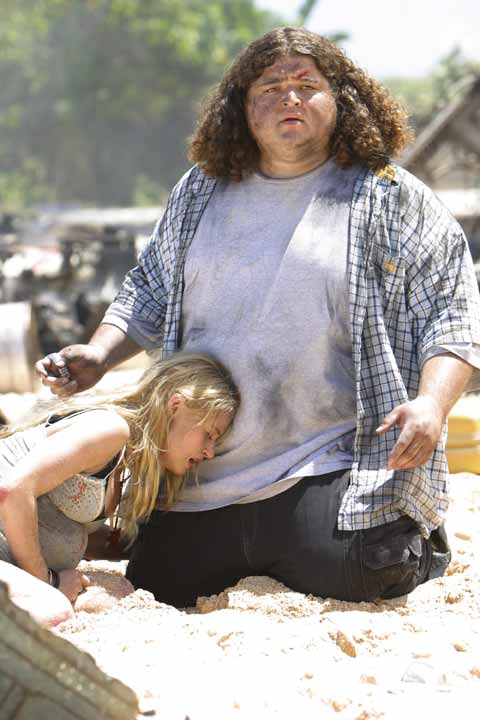
"Franz Kafka, call your office."
That was my first thought after watching the season premiere and first regular episode of Lost recently. Lost started off as part jungle adventure, part Star Trek-like plea for racial and ethnic harmony, and part philosophical/theological meditation on issues such as sin and redemption and the role of divine providence, blind fate, and random chance. Lately, however, the show seems to have veered off into this uber-creepy, super-paranoid territory. I watched Season 1 pretty faithfully, and missed much of Season 2 for one reason or another, but this seems to be the upshot:
In season 2 we learned the hatch that Locke and Boone discovered at the end of Season 1 leads down to a vast underground complex housing a vast underground, computerized, electromagnetic something-or-other that plays havoc with navigational equipment and was responsible for all the castaways being marooned on the island: the survivors of Flight 815; Danielle the crazy French scientist; Desmond, the British soldier turned round-the-world sailor; and Mr. Eko, the African warlord/drug smuggler turned faux priest. From the looks of the computers used to run the whatever-it-is, all this stuff was built in the '70s by some outfit called "The Dharma Initiative." Who they are, and why they built all this, we still don't know.
In Season 2 we also learned that there's a second group of Flight 815 survivors who apparently have their own agenda. Or is there in reality a third group that's manipulating everyone? Members of this third group kidnapped Michael and his son Walt and forced Michael to spy on Jack, Kate, Sawyer, Sayyid, et al. Michael murdered two of the second group when his spying was discovered. Jack, Kate, and Sawyer went to find Michael and get to the bottom of all of this but promptly got themselves captured by this mysterious third group. In return for their cooperation, Michael and Walt were placed on a boat and given a compass bearing that they were told would lead to rescue. Meanwhile, Locke, Eko, and Desmond tried to destroy the gianormous, computer-powered, electromagnetic thingamabob.
Now at the beginning of Season 3, it appears that this third group was on the island all along, and the crash of Flight 815 was deliberately induced by their super-duper whatchamajigger. Jack wakes up in a cell in an enormous underground--nay, underwater--complex (Must be one big frickin' island!) being interrogated by a lovely but cold-hearted woman named Juliet. She has a full dossier on him. How did she find out all this stuff and why? What does she want to know? Meanwhile, Sawyer and Kate are being held above ground in cages that look as though they were originally built for animals. Sawyer can get "fish biscuits" only if he works levers in the correct sequence, and gets an electric shock if he does not. Kate is treated to a lavish breakfast with the leader of this third group (Henry?), but she refuses any of it when he refuses to release Jack and Sawyer. He promises her "the next two weeks will be very unpleasant." At the end of last week's episode, Henry reveals that he and his group have been in contact with the outside world all along and offers Jack a Faustian bargain: if Jack will cooperate with him, Henry will release him and allow him to go home. Will Jack take the deal? Stay tuned.
Now you see why I'm confused? I suppose part of it is my own fault for missing some episodes, but Sheez, Louise! J. J. Abrams & Co. could make things a teensy bit clearer, ya know. Will somebody please explain what the funk is going on with this show?
Operation Hope

I just returned from two hours of soliciting donations for Operation Hope, the annual effort by the Knights of Columbus to raise money for organizations that assist people with mental retardation. It's a small and simple way I can help someone in need, The money Knights raise goes to Special Olympics and other state and local organizations dedicated to ensuring that citizens with mental retardation have the best and most productive lives possible. If you see somebody in your community wearing the K of C logo or a bright red and yellow smock, please consider making a small donation. Every little bit helps, and you'll get a Tootsie Roll in the bargain! Such a deal!
Thursday, October 12, 2006
My Kind of Exercise Program!
OK Go - Here It Goes Again
Wanted to see what this looked like on my blog. I can now post video to my blog! All the cool kids are doing it!
Wanted to see what this looked like on my blog. I can now post video to my blog! All the cool kids are doing it!
Subscribe to:
Posts (Atom)