Thursday, October 05, 2006

Great Minds Think Alike!


In a recent post, I commented on the outrageous piece of liturgical music abuse that is "Let There Be Peace on Earth." Seems I'm not the only one who feels this way. Via Pes, a commenter at the New Liturgical Movement blog comes the following:

Let there be chant on earth,
and let it begin with me.
Let there be chanted Mass,
the Mass that was meant to be.

With God as our Father,
singers all are we,
Let me chant with my brothers,
in pure monophony.

Let chant begin with me,
let this be the moment now.
With every Mass I sing,
let this be my solemn vow,

To pray each moment and sing each moment
of Mass, liturgically.
Let there be chant on Earth,
and let it begin with me!
Pes | 10.03.06 | #

No, wait a sec:

With God as our Father,
singers all are we,
Let me chant with my brothers,
at every liturgy.

To pray each moment and sing each moment
in pure monophony...
Let there be chant on Earth,
and let it begin with me!

That's better.


HT: Matthew at Shrine of the Holy Whapping

Well, Here's a Shocker! (Not)

Samir Khalil Samir, an Egyptian Jesuit, reports on the Muslim reaction to Pope Benedict's Regensburg speech:

At least 99% of those who protested have not even read the speech as yet. Yesterday [Sept. 29] I took part in a broadcast on Iranian television with two imams, a Palestinian Sunni and an Iranian Shiite. They all told me they had read the speech in Arabic two days after it was given. But this was not true: the translation into Arabic was prepared only eight days later, by a friend who put it on his private site. When I tried to explain the meaning of the entire text, they kept quoting the famous phrase of Manuel II Paleologus, like a script.


What I find most disturbing about that quote is perhaps not the fact that so many Muslims haven't actually read the speech. I have the general impression that general levels of literacy and access to accurate, unbiased, uncensored information are much lower in the Muslim world than in the West. What bothers me is that the imams (i. e., religious leaders, i. e., people who should be better educated and better informed) would claim to have read the speech in Arabic when they couldn't possibly have read the official text. That means either (a) they relied on unofficial, inaccurate translations, or (b) they lied. The whole "Islam is a religion of peace" line is more than a little suspect, and now it looks like some imams aren't much on truthfulness either.

Hat Tip:Amy Welborn

Saturday, September 30, 2006

"We Highly Protest Against Pop's Hypocritical About The Islam"

That's a verbatim quote. The message appeared on a sign carried by Pakistani Muslims protesting what they think Pope Benedict XVI said about Islam in a recent speech at the University of Regensburg in Germany. The sign appeared in a photograph accompanying a Catholic News Service story in my diocesan newspaper expressing the Pope's regret over negative Muslim reaction to the speech. Unfortunately, I haven't been able to find the photo online.

I've been wanting to blog about this controversy for a couple of weeks now, but I found it hard to put into words what I thought until I saw that banner. The Pope put forth some complex ideas in German, a language these poor, misguided, agressively ignorant souls don't understand, and are expressing their outrage about what they think he said in English, another language they obviously don't understand.

If they had been willing or able to read the actual speech, they would have found that the Pope's perceived criticism of Islam was actually a quotation from a medieval Byzantine emperor that few people had ever heard of, and that the emperor's views are not shared by the pope. The supposed dig at Islam was offered almost in passing. Indeed, the pope's speech is far more critical of Western rationalism, empiricism, and scientific materialism than it is of Islam.

I'm going to try to summarize what I think the pople was saying as a thought exercise and a way to help me understand it:


  1. From a synthesis of Greek philosophy and the Judaeo-Christian revelation, Catholic Christianity formulated the principle that because God is essentially motivated by love for human beings and all of his creatures, He will act in a way that is comprehensible to human reason. Therefore, it is reasonable for the Christian and the human being to believe in God, and the existence and essential nature of God can be understood, at least in part, by the use of human reason. To act violently, especially in matters of religion is unreasonable, or contrary to the nature of God. The Greek influence on Christian thought, which postulates that God acts in accordance with reason or logos is what the pope refers to as "hellenization."


  2. Islam, however, which either never had or rejecteted a hellenizing influence, presents a concept of God who is so awesome, so transcendent, and so far above human understanding that the God of Islam is not bound to act in accordance with human reason.Therefore violence has always been considered a far more permissible means of spreading the faith in Islam than it has in Christianity.


  3. Unfortunately, a process of "de-hellenization" or rejection of the idea that God acts in accordance with human reason or logos began in Western thought too, beginning with the Protestant reformers who rejected the concepts of Greek philosophy and metaphysics as inadequate to describe God. God could not adequately be described using logic and reason. Therefore, faith ultimately became something subjective and emotional.


  4. The process of "de-hellenization" of Western Christian thought continued with the 19th-century liberal German theologians who emphasized the concept of Jesus as man, moral philosopher, and wisdom teacher, but not as transcendent, incarnate Christ. Jesus as Christ was held to be a theological construct which could not be supported by empirical historical evidence.


  5. If God could not be described using vocabulary derived from philosophy and logical reasoning, and Jesus was only a wise man or a moral teacher, then the only things that human reason and logic could safely be applied to with any hope of finding truth were the physical sciences that could be empirically verified by observation and experiment. The "de-hellenization" of Western thought was complete.

  6. The tendency in Modern Western thought to rely on the rational, empirical, and readily provable and exclude the spiritual, the metaphysical, or the religious leads almost inevitably to agnosticism or atheism, a point of view the Islamic world has rightly rejected. Therefore, the West and the Islamic world cannot enter into real dialogue as long as the West has deprived itself of a real vocabulary to discuss spiritual issues that are so essential to the Islamic world view. Islamic faith and secular materialism can't comprehend each other, much less talk to each other. In order for the West and the Islamic world to enter into a real "dialogue of cultures," as the pope puts it the West will have to rediscover the reasonableness of faith in God and its own religious traditions.


That's what I think the Pope was trying to say. If my vast and erudite readership could read the speech, read what I've written, and tell me if I'm on the right track, I'd greatly appreciate it.

Apologies

A friend of mine asked why I hadn't posted to this blog in a while. Normally weekends are about the only opportunity I have to post here, and for the past couple of weekends I've been working on a fiction project. It's fun and exciting, but "It's All Straw" is still around, too. In addition, I spent much of last weekend working on Legion of Mary stuff since I am now acting president of our praesidium. Please pray for us, since our active membership appears to be dwindling. I would hate to see our praesidium wither away into nothing. Mary, Mystical Rose, pray for us.

Monday, September 04, 2006

And Speaking of Hymnody . . .

Ironically enough, just after I finish posting a piece on the glories of polyphony, comes this item. Via Drew at Shrine of the Holy Whapping, I learn that an essay by Catholic cultural critic extraordinaire George Weigel, on the most deplorable tendencies in contemporary Catholic music, is now available online. Mr. Weigel half-jokingly suggests creating a musical equivalent of the old Index of Forbidden Books, an Index Canticorum Prohibitorum. I read this essay when it first appeared in my diocesan newspaper a couple of years ago. While Mr. Weigel makes several valid points, I must respectfully disagree with him when he says the following:

Next to go should be those "We are Jesus" hymns in which the congregation (for the first time in two millennia of Christian hymnology) pretends that it's Christ . . . . "Be Not Afraid" and "You Are Mine" fit this category, as does the ubiquitous "I Am the Bread of Life," to which I was recently subjected on, of all days, Corpus Christi — the one day in the Church year completely devoted to the fact that we are not a self-feeding community giving each other "the bread of life" but a Eucharistic people nourished by the Lord's free gift of himself. "I am the bread of life" inverts that entire imagery, indeed falsifies it.


Huh? While it is true that "Be Not Afraid" and "You Are Mine" take some liberties with biblical texts and concepts, the lyrics of "I am the bread of life" (at least if they're the ones I'm thinking of) come almost verbatim from Jesus's discourses in the sixth and eleventh chapters of the Gospel of John. The congregation is recalling the words of Christ recorded in Scripture. By that logic, is any lector delivering an Old Testament reading beginning: Thus says the Lord "pretending" to be God? For that matter, is the priest or deacon reading the Gospel and quoting the words of Jesus "pretending" to be Jesus? (Yes, yes, I know, the priest stands in persona Christi, but that's different). If a lector, priest, or deacon can read the words of God, the people of God should be able to sing them.

Furthermore, while listing certain hymns that should be unceremoniously booted from every Catholic hymnal in the land posthaste, Mr. Weigel fails to mention the one that in my humble opinon is the most egregious offender: "Let There Be Peace on Earth."

This piece of drivel (I hesitate to call it a hymn) is so bad on so many levels! Theologically, yes, it mentions God, but only once, and fails to specify whose god is being invoked. Certainly not the God of Abraham, Isaac, and Jacob, or the God who became incarnate in the womb of the Blessed Virgin Mary, was born in Bethlehem, suffered under Pontius Pilate, was crucified, died, was buried, and rose again on the third day. Not that God. No, the god the authors of this song want to invoke seems to be some sort of cosmic Santa Claus who is there to make sure we get along with each other and play nice:

"With God as our Father
(Wonder how that got past the Inclusive Language Police?)
Children all are we.
Let us walk with each other,
In perfect har-mo-nee."


Bad poetry? You betcha. Pass the Pepto, I'm about to be ill.

My late father used to say that this song reminded him of that detestable Coke commercial from the late '60s and early '70s. You know the one I mean. ("I'd like to teach the world to sing . . ."). Have to agree with ya there, Dad. Musically, this song always sounded to me as if it would be more at home at a Celine Dion concert than as part of the Holy Sacrifice of the Mass. Yet I have heard parishioners and choir members, mind you, get all teary-eyed and ask, "Isn't it beautiful?" (Well, not if you ask me, but I guess there's no accounting for taste).

It seems to me that Mr. Weigel is straining at gnats and swallowing camels. If he wants to get rid of wretched hymnody, I'm all for it, but let's start at the top and dump this gigantic stinker first. Then we'll move on to the small fry.

There. I feel better. I'll go try and calm down now.

The Palace of Tallis


I have never placed my hope
in any other than you, O God of Israel,
who can show both anger and graciousness,
and absolve the sins
of suffering man.
Lord God, creator of heaven and earth,
be mindful of our humiliation.

—Thomas Tallis, Spem in alium, translated by The Tallis Scholars.

For several days now, my tiny apartment has been resounding with the magnificent polyphonic liturgical music of Thomas Tallis (1505-1585). I'm listening to him now as I write this. In a post back in April, I mentioned my fairly recent discovery of Tallis and my determination to get a CD of his music, but I couldn't decide on which one. After much dithering, I chose The Tallis Scholars Sing Thomas Tallis, a two disc collection by the English choral group who, as their name implies, devote themselves to the music of Tallis and other Renaissance liturgical composers. I chose this album because of the completeness of the collection, the thoroughness of the liner notes, and the inclusion of complete translations of all the Latin lyrics. This was despite the complaints of some listener-reviewers on Amazon.com who felt that the soprano voices tended to overwhelm others and predominate on Tallis Scholars recordings. My only real quibble with this album is with the packaging. The little tray holding the two discs broke off from the rest of the container on the second day I had the album. Surely there must be a simpler and more durable way to package this music! On balance, however, I would say that the strengths of this collection far outweigh the weaknesses.

The collection itself includes nearly three hours of music from throughout Tallis's career, both pieces he wrote for the Roman Catholic liturgy in Latin and the Anglican liturgy in English. I find that while the English material such as "If Ye Love Me," is indeed quite beautiful in a stark, severe sort of way, it lacks the soaring, transcendent quality of the Catholic, Latin compositions. Judging from the music alone, I would say that in his heart of hearts, Tallis was and remained a Catholic even though he lived in a time of considerable social and political pressure to become Protestant. His sympathies, musically speaking, are plainly with the Catholics. The liner notes point out that Tallis's Catholic and Anglican pieces are written in significantly different styles because the Anglican liturgy placed a premium on the congregation's ability to understand the text. Since the Catholic compositions were in Latin to begin with, the congregation's ability to understand the text was probably considered somewhat less important, which allowed Tallis to be freer musically and create layers upon layers of sound. Again, judging from the music alone (and I am certainly no expert), I would say that perhaps Tallis's intent with his Catholic, Latin compositions was not so much to inspire reflection on a text but to create a mood, a general atmosphere, if you will, of prayer, praise, and adoration. Spem in alium, quoted above, is usually considered Tallis's masterpiece, but I find myself especially moved by Gaude gloriosa Dei mater ("Rejoice, O Glorious Mother of God"), a hymn to the Blessed Virgin that goes on for over 15 minutes. To me, this music is what heaven sounds like.

I expect this is only the beginning of my adventures in polyphony. I'd like to get some more Tallis recordings (perhaps by different ensembles to compare their interpretations of various pieces), as well as works by Byrd and Palestrina. Stay tuned.

Friday, September 01, 2006

Medieval Madness!

Attention medievalists! Did you know Geoffrey Chaucer Hath a Blog? That's right. The author of The Canterbury Tales has entered the cyber-age! (Neat trick, considerin' ol' Geoff died around 1400). Two bloggers calling themselves Le Vostre GC and Katherine de Swineford have created a spot-on parody of Middle English prose, and, for English majors at least, one of the funniest blogs around. I wasn't always a lowly librarian and Mark Shea/Amy Welborn wannabe, no sir. Back in the day I was a graduate student in English and American Lit. specializing in medieval and Renaissance literature, and for a split nanosecond, this blog made me think nostalgically about graduate school. I had a professor who would have loved it. I daresay the authors are two grad students in medieval studies facing rather bleak employment prospects who've decided to have a bit of fun at Geoff's expense. Don't miss Serpentes on a Shippe, their send-up of Snakes on a Plane.

Chaucerians looking for chuckles might also try Geoff Chaucer, Medieval Dick. If the Parlement of Fowles had included The Maltese Falcon, it might have gone something like this. Newly illustrated--with tapestries! (For those of you concerned about bad language, the word "Dick" in this case refers to the slang term for detective, not a vulgarism for a certain portion of the male anatomy). Enjoy!

Astounding Adventures Now Online!


Happy Labor Day to all citizens of the blogosphere and greetings to all my faithful readers (both of you)! If you're looking for some light reading this weekend (and I do mean light), you might try Astounding Adventures, my online pulp magazine and fiction archive. In a previous post I confessed desire to start writing again and my unfortunate fondness for old-fashioned adventure fiction of the kind you might have found in the old pulp magazines of the 1930s and '40s. Astounding Adventures is my tribute to the genre and a central location for all the fiction I've posted to date. There you'll find a couple of Star Trek stories and a story inspired by Michael Chabon's extraordinary novel The Amazing Adventures of Kavalier and Clay, a loving tribute to the "golden age" of comic books, pulp fiction, and old radio.

I plan to add more stories as time goes by. In honor of the Superman Returns movie that came out earlier this summer (which I enjoyed hugely, BTW), I decided to dust off an old idea I had for a story in which Superman meets The Shadow. I will say no more about it at present, as it's in its earliest stages and may take awhile to complete. In the meantime, enjoy what's there and let me know what you think.

Friday, August 25, 2006

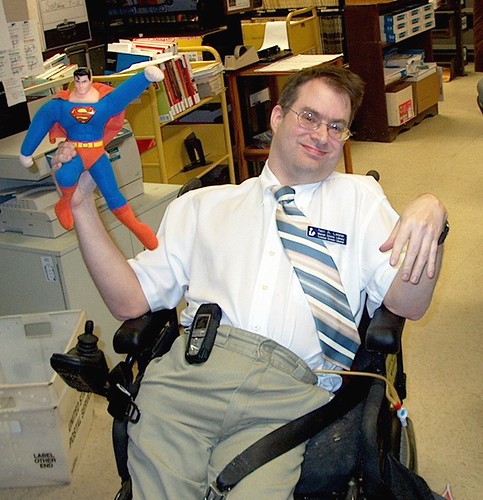
The Man of Styrofoam!


Supes&Me, originally uploaded by Niall Mor.

Received ol' Supes here as a belated birthday present from a co-worker. Another co-worker snapped the picture.

Words to Live By

from my friend Linda:

They can't get your goat if they don't know where it's tied.

Sunday, August 20, 2006

Blasts From the Past

Now that my parents are gone, I find myself really treasuring reminders of them and all the generations of my family that came before us. I received one such really big reminder last weekend: a small antique desk that belonged to my great-grandmother. It's not a roll-top, but I don't know what this style of desk would be called. The writing surface folds down from the desk supported by slats or rails that can be pulled out from the body of the desk. I understand that my great-grandfather Roberts bought it for my great-grandmother, and that at one time it sported an elaborate, highly carved top piece that held a mirror. Such fru-fru was probably too much for my great-grandmother's eminently practical Germanic sensibilities, and she had that top piece removed. When my mother was a little girl and went to visit her grandmother, she was allowed to sit at the desk and play while her grandmother took a nap. Years later, as a boy I played at that same desk. As a kid I was fascinated with the idea of being a private detective along the lines of Sherlock Holmes or Jim Rockford, and that desk was my "office." It has cubbyholes and drawers aplenty, just the kind of thing in which the Hardy Boys might find a long lost treasure map or a vital clue. I kept hoping I would find a secret compartment or a false bottom in one of the drawers. No luck. I'm also sorry to report I haven't found a secret passage to Narnia, Middle Earth, or Hogwarts School of Witchcraft and Wizardry, but it looks to me like the sort of furniture that could lead to such a place.

I've loved that desk ever since those days of daydreams, and Mom promised me that I could have it. Last weekend my sister and her husband delivered it (in the rain, bless their hearts). I feared it would be too big for my tiny apartment, but there was a perfect spot for it in my living room. Almost magical, one might say. It's the first piece of furniture in the apartment that wasn't bought or donated when I moved here, so it's the first piece of furniture that has a real history and a connection to happier times. I also have my great-grandmother's lovely, delicate tiny gold Rosary inscribed with the words "Mrs. J. J. Roberts" and a date, Oct. 26, 1913. It must have been a birthday or anniversary gift. I have my Dad's old wristwatch, but my skinny wrists can't accommodate it. He left some big wrists to fill.

To my faithful readers (all two of you), I offer this advice. Remember the past, live in the present, and look to the future.

Friday, August 11, 2006

The Cable Guy: Addendum

We had some thunderstorms earlier this week, bringing much needed rain to these parts, but as a result of the storms, one of the three shopping channels went out. That's right. There are not one, not two, but three shopping channels in my basic cable package of fewer than two dozen total channels. How much bling does one need?

Saturday, August 05, 2006

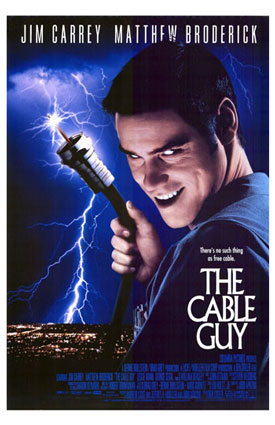
The Cable Guy


Well, I did it.

About a month ago I signed up for cable, something I resisted doing for a long time.

Ya see, it's like this. My sister-in-law asked me if there was anything of Mom's that I wanted. I asked for Mom's TV since it was about twice the size of the one I had. I don't watch much regular TV, but I do rent movies from Netflix so I figured a big screen would be nice when I watched a movie. This new, bigger TV didn't have "rabbit ears" or an external antenna, so it was pretty much cable or nothin.' I signed up for the bare bones, no frills, most basic, basic, basic of packages (all the broadcast networks, PBS, C-SPAN, and a couple of Christian stations) because all the other packages were more expensive with a lot of stuff I'd never watch anyway.

I have to say that even with this minimalist approach it's been interesting. I can now get not one, but two NBC stations (why I don't know), while before I couldn't really get even one, except in good weather. One show I've discovered via cable is "Sue Thomas: F. B. Eye". It's about a young deaf woman who lands a job with an elite team of FBI agents specializing in surveillance because of her acute powers of observation and skill at lip reading. Since the show originated on the former PAX-TV channel, a Christian cable station, it's light on onscreen violence and heavy on a positive, uplifting, vaguely religious message. Sue frequently tells her fellow agents or the people who come to them for help, "I prayed for you," or "God brought your daughter back," or something similar. Think of it as "Touched by an Agent," a cross between "Without a Trace" and "Touched by an Angel."

Sometimes, however, the show's efforts to be heartwarming come across as just plain sappy, and if you want gritty realism and hard hitting crime drama, this isn't the show for you. Sometimes the plot twists make my implausibility meter go off the scale. In a recent episode, an agent's gambling addiction that he had concealed resurfaces when he goes undercover to catch a crook participating in a high stakes poker game. This is the FBI, for Pete's sake! Don'tcha think they'd know if one of their agents had a gambling problem because he'd be a security risk? On second thought, some of the worst spies and security leaks in this country in recent years have been FBI agents, so I guess it's possible.

What makes the show interesting to me is the fact that Sue Thomas is a real person (albeit a good bit older and less telegenic than her TV alter ego) who did have a real job with the FBI, and the actress who plays her is really deaf, so there is a grain of truth in these highly dramatized and romanticized adventures. I'm encouraged to see somebody with a disability playing a lead role in a series with a positive message.

Unfortunately for fans, however, PAX-TV was recently bought out by somebody else, who changed the name and appears to be in the process of changing the station's focus and programming. The producers of "Sue Thomas" had already stopped making new episodes, and now the parent company wants to scale the reruns back to once a week and possibly eliminate the show altogether. There are no plans to re-release the show on DVD. I just checked on the show's website, and the small but vocal fanbase who post on the message boards are upset. I can understand why. Even though I can see flaws in the show, and even though I've only been watching a short while, the show has grown on me. This looks like yet another example of a corporate TV behemoth obliterating an original, entertaining show that didn't score high enough in the ratings (i.e., make enough money), in order to replace it with just more of the same ol' same ol'. That's the free market at work, baby! *Sigh*

Sunday, July 30, 2006

I Cleaned Off My Dining Room Table!

I have just finished cleaning off my dining room table! That may not sound like much to you, but it's a huge step for me. There are still some odds and ends on it, but now it's simply a matter of tidying up, not a major archaeological excavation. Until this weekend that table was a hopeless jumble of bills, books, old mail, and general junk several layers deep, a perfect metaphor for my life.

Somewhere along the line, in late 2004, I think, when I realized my father was terminally ill, and I developed serious health problems and heartaches of my own, I simply allowed my life to go off the rails in some fundamental way. The daily responsibilities of life were too much, I thought, and I allowed stuff to pile up on top of stuff on top of stuff. As time went by, the problems grew bigger and more difficult to deal with. "It's too intimidating," I thought. "I'll just sit here and watch TV or read--or blog--instead."

Now that both my parents are gone, however, I've been forced to take a hard look at my life and take responsibility for myself as I never have before. I've been in counseling for depression for years, and this past Friday, as my counselor asked me about my job, all my frustrations poured out. I realized it was time to seriously seek another position, something I've been thinking and talking about doing for awhile now. Friday I decided it was time to do something about the table, and yesterday and today, by the grace of God, I made it happen.

I sorted the bills into folders and threw most of the rest away. Now the next step will be to sort through the bills and come up with a complete accounting of how much I owe. My mother left me a modest annuity, so I can use some of those funds to retire some debt and invest the rest. May God grant me the grace to make wise decisions in the days to come! This feels like the beginning of a whole new beginning.

Thursday, July 20, 2006

Birthday Number 43

Today is my 43rd birthday. Tomorrow, my brother Bill will be arriving, and we'll be going up to Charlotte to rendezvous with my other brothers and sisters in order to have a joint birthday celebration with one of my sisters, whose birthday is three days after mine.

On the one hand, I have to say I don't feel much like celebrating. My mother's death is still hanging heavy on me and all the kids. It's a weird thing to be getting birthday cards and condolence cards at the same time. On the other hand, I think a family gathering to celebrate a happy occasion will do us all good after the ordeal of waiting through Mom's final illness. She wouldn't want us to be too sad too long. Here's hoping for a happy birthday, but I sure wish Mom could be there.

The Story of I Love You


A cherry when it's blooming
It has no stone
A chicken when it's piping
It has no bone
The story that I love you
It has no end
A baby when it's sleeping
It's no crying.


"The Riddle Song."

I took a brief hiatus from blogging to try to process my mother's death. I decided I needed to come back.

Thanks to all of you who have left comments or e-mailed with prayers and words of comfort and encouragement. They are much appreciated.

I want to tell you about what has happened since I last blogged. The night before my Mom died, we all gathered in her room. I think we all had an intuitive sense that it would be her last night with us. My oldest sister Susan was softly singing "The Riddle Song" to Mom and said that Mom had taught it to her when she was a little girl. I knew Mom loved old folksongs, but I didn't know "The Riddle Song" was one of her favorites. We started singing any old folksongs or snatches of songs we could think of. One in particular that I remember that Mom always liked is "High Barbary".My brother Allen got out his guitar and started playing some original music he had written. I know Mom liked that.

A few days later at the memorial service, my niece Maggie got up and sang "The Riddle Song" again and accompanied herself on the guitar. I knew she had been playing acoustic and electric guitar for quite awhile, but I had no idea she was so accomplished! It was beautiful.

The memorial service was lovely, except for one thing. For some reason no one is quite sure of, Father Jim did not allow any time for family members to give eulogies or tributes. He did say afterwards that he had an important meeting at the Chancery that he couldn't avoid, so maybe that forced him to cut the service short. Or perhaps there was some miscommunication between Father Jim, the family, and the people at the church who planned the service. Here is what I might have said had I been given the chance:

When I think of my mother these days, I think of two things. One is her definition of heaven, one of the wisest and most beautiful things she ever said to me: "Heaven is where all the people you love know each other." The other is the fact that she was such a great cook who loved bringing her family together for a great meal. But her meals were never about linen napkins and fancy place settings with everyone on their best behavior. Whether it was a giant hamburger with everything, shad prepared the Charleston Receipts way, or a huge salad full of fresh vegetables, Mom's meals were all about good people enjoying good food and having a good time. If there wasn't enough room with the grown-ups, you could grab a seat at the kids table or even on the living room couch. Want some more? Help yourself!

Now I believe Mom is in heaven where all the people she loves know each other. Dad is there, Mary Darby is there, and all the people we have known and loved who have gone before us are there. And we are there, too. For I believe Mom has passed out of time and into eternity, where there is no past and no future, but only an eternal now. Therefore, to Mom it seems we are there and have always been there. In a few moments more of time, we too will enter into eternity, and it will seem to us too that we are there and have always been there.

More than once (Mt. 25:1-14, Rev. 19:7) Scripture compares heaven and the Kingdom of God to a wedding feast, the marriage feast of Christ the lamb of God. I believe Mom is up there right now, helping out with that wedding feast, making sure the people she loves are comfortable, happy, and have enough to eat. Maybe she's sharing her recipe for blueberry muffins with the angels! I love you, Mom.

Saturday, July 01, 2006

Mom's Obituary

Here is the obituary I wrote for my Mom.

Cecilia Allen Roberts Leslie of Indian Trail, N.C., was called home to God on Thursday June 29, 2006.

She died at home after an illness.

She was born October 19, 1924, in Columbia, SC, the daughter of the late John Cornelius Roberts of and the late Agnes Cecilia Allen Roberts, also of Columbia. She graduated from the University of South Carolina with a bachelor's degree in journalism. After a brief career in radio and newspaper journalism, she married the late William Stewart Leslie of Birmingham, Alabama, and largely devoted herself to providing a loving and secure home for their six children. They were married for 55 years. For nearly 20 years, Mr. and Mrs. Leslie operated a retail business, Clocks & Crafts, in Murrells Inlet and Pawleys Island, SC.

Mrs. Leslie is survived by her six children: Susan Leslie of Charlotte, NC; John Stewart "Jay" Leslie of Dallas, Texas; William Farley Leslie of Chapel Hill, NC; Edward Allen Leslie of Indian Trail, NC; Mary Grace Leslie Davis of Little River, SC; and Neil Roberts Leslie of Marion, SC; five grandchildren; and two great grandchildren, She will be remembered for her unfailing wisdom, compassion, sense of humor, and strength of character, and will be sorely missed by all who knew her.

A memorial service for Mrs. Leslie is scheduled for Monday July 3 at 11 AM at St. Luke Catholic Church in Mint Hill, NC. The Rev. James F. Hawker will officiate.

Thursday, June 29, 2006

Cecilia Roberts Leslie, RIP

I'm back in South Carolina, at least temporarily. My mother, Cecilia Roberts Leslie, passed from this life today at about 6: 45 AM. My sister-in-law and a very conscientious nurse's aide were with her. They said her passing was very peaceful. There was no pain, no struggle. My brother Allen called everyone else and we gathered at the house a few minutes later. We said goodbye, wept, prayed, and comforted each other as best we could. My brother Bill and I decided it would be best if we went back to my house and prepared ourselves for the memorial service on Monday.

I don't have the words to say much more about it right now. At Allen's request, I've written an obituary for the newspapers, but those few lines of stiff, formal language don't do justice to the wonderful woman who was--and is--my Mom. As the days and weeks go by, no doubt I will be blogging more about her. For now I can only offer this prayer:

Eternal rest grant unto her, O Lord, and may perpetual light shine upon her. Amen.

Rest in peace, Mom. I love you.

Tuesday, June 27, 2006

The Wait Continues

I am still in North Carolina. Mom appears to be weakening almost daily. Monday morning, my brother's pastor came over yesterday to give her the Anointing of the Sick and a general absolution. He did his best to put everyone at ease, telling lots of funny and comforting stories. I could see Mom smiling while he was here. She enjoyed that.

Almost as soon as Father Jim left, however, Mom began complaining of more pain, and we decided it was time to arrange for her to get stronger pain medicine and more of it. My brother Allen became somewhat frustrated because he had trouble making contact with the doctor and hospice workers to authorize the change. The most wrenching part of this for all of us is to see Mom in pain and be able to do so little about it. Once the new medicine arrived, however, it seemed Mom was able to relax more and get some extended deeper sleep that she desperately needed. The hospice nurse came and evaluated her, and alerted us all that her breathing was becoming shallower and more irregular. According to the hospice folks, this is usually a sign of approaching death, but it's impossible to say exactly when that will come. Last night before my brother Bill and I went back to the motel, I sat with her for a few minutes, and even I noticed the irregular breathing pattern.

I am torn. Of course I want to be with Mom, but it's so emotionally demanding that I can only be in the room for a few minutes at a time. Today I said the Tessera, the set of prayers associated with the Legion of Mary, and the Divine Mercy Chaplet while I was with her. We all have to take frequent breaks and draw strength from simply being together and doing normal family stuff such as reading and watching TV. Last night as we gathered for dinner after a long day, we found ourselves talking about what a great cook Mom was and how she loved to bring the family together for a great meal. Even when she can't be with us physically, Mom is still in our hearts.

Most Sacred Heart of Jesus, have mercy on us.

Immaculate Heart of Mary, pray for us
.

Sunday, June 25, 2006

Waiting

I am live blogging from North Carolina where we are waiting ... for what?

My mother is gravely ill with cancer and a broken rib. I think we're very close to the end now. My brother Allen called me early Friday morning and said, "If you want to see Mom, you had better come sooner rather than later." My brother Bill and I arrived Saturday afternoon. All of my other brothers and sisters and their respective spouses are here too.

Mom is shockingly pale and frail--downright gaunt, with sunken eyes. She needs help to roll over, and barely has the energy to talk when she's awake. When I arrived, she was dozing in a new recliner chair because it's difficult for her to lie completely flat in bed and be comfortable. Allen has engaged a nurse's assistant to sit with her during the late night and early morning so that he and his wife Nita can get some sleep. They are exhausted. During the night, the nurse's assistant moved Mom to the bed, and she's been resting there intermittently ever since. We've been taking turns visiting her and tending to her needs as best we can.

I have never seen Christlike love in action so powerfully as I have in the last 24 hours or so. My brothers and sisters have to give Mom water from a sippy cup, and when she feels like eating, we spoon feed her cream of wheat, pureed peaches, and the occasional cup of chicken broth. They do it with such incredible tenderness! It's a small--wholly inadequate--way we can say thank you for the millions of times Mom cared for us with equal tenderness over the years when we were sick.

Yet even the in-laws and the newest members of our family that don't have that long history with Mom recognize what an extraordinary woman she is and love her for it. Yesterday, Mom was complaining of itchy and dry skin. My sister-in-law Carla, the newest member of our family, gently and tenderly rubbed on some lotion so that Mom could feel better. I was so touched by that! I sat and quietly said the Rosary while she slept earlier this afternoon. There is little I can do physically for Mom because of my disability, and it makes me feel guilty, but she told me she's glad I'm here.

Even though she's so ill, she's still Mom, with a wry sense of humor and a never-ending concern for her kids. A couple of nights ago the nurse's assistant recognized that Mom needed a catheter and demanded that a nurse come out in the wee hours of the morning to put one in. We started talking about how important it is to demand what you need when you're sick. I said, "You don't get extra points for being a hero." She said, "You don't even get extra points for being polite." She could still give a lopsided smile when somebody told a joke.

As if all of this situation with Mom weren't bad enough, I've been hobbled for the past couple of weeks by a nasty intestinal something-or-other. Yesterday, I was feeling particularly vile. The first words she said to me today were a question about how I was doing. When I told her I was feeling better, she said, "I'm so glad." She worries about her daughter-in-law Nita, who worries about her. Always a Mom!

We are simply waiting for whatever happens next.

Mary, help of Christians and help of the sick, pray for us.

Saturday, June 17, 2006

I Am Not Worthy!


I have been given an honor I did not expect.

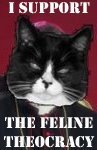
K T Cat, Maximum Leader of the Feline Theocracy, has graciously granted me the title Holy Scribe of the Feline Theocracy. You are too generous, O Feline One! May you be free of hairballs forever! Jacob the Syrian Hamster, faithful beadle of the Theocracy, was particularly impressed with the tribute I wrote to my Dad. What can I say? I merely wrote from my heart. I will strive to be a faithful servant of the Maximum Leader, although it may be difficult for me to scratch behind her ears since I am in South Carolina and she is in San Diego.

Update on my Mom

Thanks to all of you who have been praying regarding my Mom, Cecilia (Cele for short), and her battle with cancer. Here's an update. I'm afraid the news isn't good. She had her PET scan last Sunday. The cancer is in her lungs and lymph nodes. The oncologist is estimating that without chemo, she has perhaps six months to live. If she takes chemo, she could add two or three months, but that's about it. As if that weren't bad enough, she's got other health problems--osteoporosis, stress fractures, chronic back pain, muscle spasms, and deteriorating vision, to name a few--that would make chemotherapy even more difficult than it normally is. She hasn't made any decision yet, but my brothers and sisters tell me she's leaning toward taking no treatment because chemo would be an awful lot of discomfort for very little benefit. The kids will do everything we can to make her remaining time as comfortable as possible and will spend as much time with her as we can. One of my brothers and I are going up to visit her next weekend.

I am holding up fairly well by leaning on family and friends here in town and in other places that I stay in touch with by telephone. I'm very blessed to be part of a close-knit family. When there's a crisis like this, we rally and support each other. I must confess I'm having a hard time praying about this because I don't know what to pray for. I don't want my mother to die, but I don't want her to linger and suffer needlessly, and I don't want to oppose God's will. Please pray for Mom and for the whole family.

Thanks.

Thursday, June 08, 2006

Comments! We Get Comments!

Well, goshdarmit, it looks like somebody reads this li'l ol' blog after all!

I e-mailed Rod Bennett to tell him how much I was enjoying his series on C. S. Lewis and pulp fiction and invited him to visit this blog. Rod graciously responded that he had already seen my blog.

Janjan left a comment thanking me for mentioning her blog and adding her to the blogroll, and another wishing me luck in my fiction writing endeavors.

Finally, I must make a correction and express my thanks for the merciful benevolence of K. T. Cat, Maximum Leader of the Feline Theocracy. In my mention of The Scratching Post blog, I erroneously identified Glenn Reynolds as the human member of the triumvirate that runs TSP. The human left a comment informing me that he is not Glenn Reynolds and adding that he wishes to remain an anonymous servant of The Maximum Leader. Many thanks for your charity in not rebuking me further for my error, O Feline One. I am not worthy. May you have catnip, fresh milk, and balls of yarn forever!

It's nice to be noticed. I feel almost famous. Are my 15 minutes up yet, Mr. Warhol?

Sunday, June 04, 2006

Fiction Is a Necessity


I've been thinking about writing again.

Not just blogging--but writing fiction, too. Life seems a mite drab these days: Get up, go to work, come home, look at stack of unpaid bills, ignore unpaid bills if possible, mourn deceased father, worry about elderly mother, regret mistakes and missed opportunities, especially in relationships. Lather. Rinse. Repeat.

There's nothing like the death of one parent, the illness of the other, and your own physical problems to make you think about your own mortality and the fact that none of us knows how long we have on this earth. I don't want to spend my whole life slogging through stuff I don't want to do and miss out on some of the things I do want to do. I realize life can't be a 24/7/365 thrill ride, and that we all have to carry our crosses, but I would really like something to get excited about in my life--something that adds color and challenge, and a feeling of having created and accomplished something good. Something that makes me get up out of bed and say, "Wow! Today I get to . . . (fill in the blank)." Writing may be that something. I have notes and drafts for several unfinished fiction projects on my hard drive--mostly of a comic booky, pulpy, science fictiony, type nature. I, the holder of a Master's in English, with a specialization in Renaissance Lit., have to confess: I love pulp, or at least I used to. Somewhere along the line I lost interest and it became much less important. Perhaps I overdosed on it and provoked a reaction. Can I pick it back up again? I don't know.

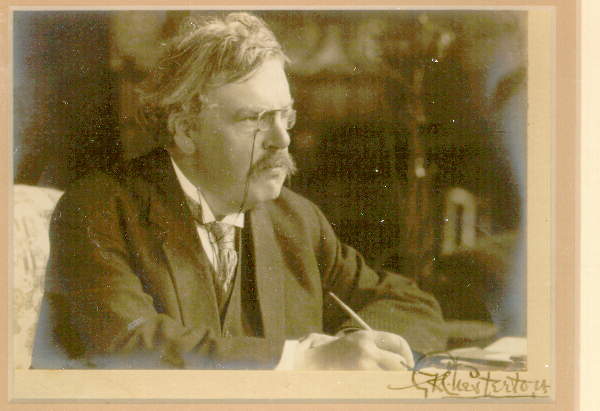
Why pulp? Why not higher brow literature? I've written some of that too over the years. I think for now I would just like to try to write something fun. Fun to write and fun to read. No moral, no message, no deeper meaning other than the victory of good over evil, which might be the theme of all great literature. I want to see the hero save the world and get the girl. I think all literature, even if it deals with serious issues, arises out of a need to imagine, to create, to pretend, to play. I want to play, at least for a little while. Pulpy, comic booky, science fictiony type stuff appeals to me, I suppose, because it brings that desire to play and the desire to see good triumph over evil down to their most basic and obvious level. It's hard to take Superman seriously as a work of literature, but it's easy for a nerdy guy like me to identify with Clark Kent, wish he were Superman, win the love of a girl like Lois Lane and whup a villain like Lex Luthor. As the great Catholic essayist G. K. Chesterton observed:

The simple need for some kind of ideal world in which fictitious persons play an unhampered part is infinitely deeper and older than the rules of good art, and much more important. . . Literature is a luxury; fiction is a necessity . . The poor--the slaves who really stoop under the burden of life-- have often been mad, scatter-brained, and cruel, but never hopeless. That is a class privilege, like cigars. Their drivelling literature will always be a "blood and thunder" literature, as simple as the thunder of heaven and the blood of men.


I'm not poor, but every once in a while I feel stooped under the burden of life and need some "blood and thunder" to give me hope. Let's go make some blood and thunder!

Blogroll Business

Howdy once again, blogfans, and welcome to the NEW AND IMPROVED "It's All Straw." For your convenience and mine, the blogroll on the left has been alphabetized and expanded for easy access to favorite blogs old and new.

Among my particular new favorites, Rod Bennett over at tremendous trifles has been running a fascinating series of posts on the influence of pulp and science fiction on the writing of C. S. Lewis. (part one, part two, part three, part four) What Rod has discovered may surprise you. Seems ol' "Jack" Lewis was more of a sci-fi geek than we thought. Do check it out. I know I've railed against some really vapid pop culture on this blog in the recent past, but I've always had a soft spot for fantasy, sci-fi, adventure fiction, classic pulp, and their modern day descendants, such as Star Trek and Star Wars.

Once a Chicken, Now a Fish is the story of blogger Janjan's circuitous path from Reform Judaism to Catholicism, told with dry wit, honesty, and style. Her blog With Issue continues the story as she struggles to live out her faith like the rest of us, while looking out on this crazy world we live in. Shalom, and welcome to the Church, Jan!

The blogger known only as Anonymous Teacher Person gives us a glimpse inside her Catholic high school classroom with her blog Scrutinies. Her career as a Teacher Person may be coming to an end, however, as she and her TeacherHusband are moving and mulling the possibility of having more TeacherKids. Prayers and best wishes as they consider what comes next! Blogger Rachel Swenson Balducci tells us what it's like to live, love, and bring up kids Catholic in her male-dominated Testosterhome.

Blogger and author Mike Aquilina instructs us in The Way of the Fathers and explains why the teaching and practice of the earliest Christians are still relevant today. For my money, knowing something about the real history of the early church is a useful and badly needed corrective to all of the nonsense and lies spouted in The Da Vinci Code.

Over at The Scratching Post team bloggers KT Cat, Jacob the Syrian Hamster, and their pet human, Glenn Reynolds, "make the business case for kindness." You'll find conservative political commentary and "World of Good Blogburst" posts which describe various opportunities for community service. The first-person (um, first-animal?) reports on the ever-so-trying life of KT and Jacob are hilarious, but woe to ye who incur the terrible wrath of the mighty Feline Theocracy! Ignore their "catwa" at your peril, unbeliever!

Finally, even though he's been on my blogroll for awhile, I gotta give a shout-out to my former colleague Mark Mossa, S. J. and his blog You Duped Me, Lord. When I last saw him, Mark and I were graduate students in English at the University of South Carolina. Now Mark is a Jesuit "scholastic" or candidate for ordination, scheduled to become a priest in 2008. God bless you, Mark, as you pursue this vocation.

Watch for new and interesting additions to the blogroll as I discover them.

Saturday, June 03, 2006

Bad News

It looks like my Mom's cancer is back.

She had one bout of lung cancer in 2002-2003. My Dad died of lung cancer in 2005. She actually got sick before my Dad did, but the doctors caught the cancer in its early stages and it responded well to chemotherapy and radiation. This time it looks as though there are multiple tumors in both lungs and they may be farther along than the first time. I'm getting my information indirectly from my brother, who's getting it from my sister-in-law who got it from the nurse in the oncologist's office. Mom herself is pretty stoic about the whole thing, implying that the doctor's just over-reacting, or that she's just old and ill health is to be expected. We'll have more definitive information after she has a PET scan next weekend. There is still much we don't know. Prayers are requested. My Mom's name is Cecilia, Cele for short.

I am trying not to freak out over the whole thing. It doesn't seem quite real yet. But it is depressing. I just finished writing a remembrance of my Dad, and the thought that I may soon have to write one for my Mom, is disturbing to say the least. I will keep you posted, adding more details as they become available. God's will be done.

Monday, May 29, 2006

Remembering Dad


Today is Memorial Day, the day Americans pause to remember those who gave their lives in service to their country. Today I would like to remember my Dad, William Stewart Leslie (1923-2005). He did not fall in combat, but he served honorably in World War II and the Korean Conflict. He loved his country and taught me to do the same. He fought the real battle to provide for his wife and six kids, all of whom grew up to become decent, honorable, compassionate men and women because of lessons he taught us. He passed from this life in February 2005 after a long battle with lung cancer.

In World War II he served with the U. S. Ninth Air Force based in England. For the most part, he flew P-51 fighter planes. One of his assignments was to shoot down German V-1 and V-2 rockets launched from Holland. He said the rockets were so slow and crude that often just the "prop wash" or air turbulence from his plane flying past the rocket was enough to send it crashing harmlessly into the sea. He told us stories of the funny things that happened during his wartime service: the time he got his cap blown off because he unwittingly stood in front of a loaded cannon, or the time he was appointed "mess officer" for his unit despite the fact that he had no idea how to run a mess hall. He never talked about the scary things, of which I'm sure there must have been a few. I believe he was shot down once. He didn't like to talk about it. Towards the end of his life he had nightmares from which he woke up screaming. I couldn't help wondering if those came from long-buried frightening moments from his war years.

I asked him once if there was ever a moment when he was afraid for his life, scared that he might die. No, he replied, because when you're 19 years old, you're too dumb to be scared. You are convinced that you're 20 feet tall and bulletproof. The other guy will get shot, not you. When I saw TV news stories about the dedication of the World War II Veterans Memorial, I was overcome with a wave of pride and affection for him and called to tell him so. His response, like so many others of "The Greatest Generation" was typical.

"Shoot," he said, "I didn't really do anything."

Yes, you did. And we are grateful.

During the Korean Conflict he was recalled to active duty from the reserves. Somewhere along the way he mentioned his desire to learn Russian, and the next thing he knew, he was enrolled in a special program in Washington, D. C. to study Russian language, history, culture, and geopolitics. It wasn't top secret, but it was confidential. He was instructed to wear civilian clothes and, if asked, just say that he worked for the Defense Department and leave it at that. I believe the photo you see might come from this period. You'll notice that he's standing or sitting against a neutral background, he's well dressed, and looking directly at the camera with a serious expression. It looks like an ID or passport photo to me, but I can't be sure.

Many of his professors in this special program were White Russians or anti-communists who fled after the revolution of 1917. He was amazed at what they knew and how they knew it. Once, after class, one of his professors approached him furtively, looking both ways before speaking.

"Gaspadin (Mister) Leslie," the man said in Russian, "You are . . . pilot, da?"

"Da," Dad replied. He hadn't told anyone he was a pilot.

"I teach you Russian. You teach me to fly, da?"

"Da."

Dad went to a local airport, rented a small plane, and took his professor up for a flying lesson, but quickly realized he didn't have the specialized vocabulary needed to explain the more technical aspects of flying: artificial horizons, ailerons, rudders, pitch, and yaw, and so forth. His efforts to teach his teacher how to fly ended right there, but I've always thought it was a great story. There was also the time a friend of his passed himself off as a native Russian to impress a bimbo and Dad played along; or the time a drunk driver rammed into the picture window of the trailer Dad had rented while he, Mom, and my sister Susan (an infant at the time) were driving cross country. Dad was full of stories, and he told some of them so many times, we were sick of them. Now that he's gone, I'd give anything to hear him tell them again.

He was not a perfect man (no one is), but he was a good man. I think, like many men who came of age during the Great Depression and World War II, he found it difficult to express his deepest emotions in public. Bragging, being conceited, or having an overly exalted opinion of oneself was the worst sin a man could commit. You were supposed to work hard, do your duty, and not call attention to yourself. People made fun of Bob Dole, also a World War II veteran, for sometimes speaking of himself in the third person ("Bob Dole knows . . .") but I believe the habit came out of that fundamental modesty of his generation. Nowadays, when celebs and ordinary people get on TV talk shows, air their dirty laundry in public, and then get all weepy while the rest of us watch, such circumspection and humility are refreshing.

Sometimes, however, I think Dad went too far in trying to prevent us from becoming conceited. His favorite tactic was to conceal his real feelings behind a joke or a left-handed compliment. It made me think sometimes that nothing I did mattered to him. In college I was nearly a straight A student, but in college I also acquired my first serious girlfriend, and I loved her with a passion that only those in love for the first time can manage. I was worried that my grades were slipping because we were spending so much time together. I needn't have worried. Dad's response? "He had a 4.0, but then he met this girl. Ha, ha, ha." It made my blood boil.

I once asked him angrily why he seemed so allergic to paying me a compliment in public. "Because I don't want you to get the big head," he snapped back. We had some friction over the years, to say the least. If there was any good thing about his long final illness, it was that we each had time to look past the bluster and bravado and hurt feelings and say to each other, "I love you and I am proud of you."

I know that he loved me despite the fact that he sometimes had trouble expressing it. He had many jobs throughout his life, and some were more successful than others: airline pilot, filmmaker, salesman, retail business owner. For most of the time I was growing up, he was the regional sales representative for a company that sold heavy construction equipment. His territory extended from Maryland to Mississippi, and often he would leave on business trips on Monday morning and not return until Friday night. That had to be hard, lonely work, but he did it because he loved us. He never once failed to provide us with anything we needed (and often just things we wanted) even if it meant considerable personal and financial sacrifice for him. My three-week trip to England when I was in college that he paid for is a prime example. Now that I'm living on my own and struggling to pay bills just for myself, I have a glimpse of what he must have struggled with to support and provide for a wife and six children.

He stayed with me faithfully whenever I had to be hospitalized for surgery related to my disability. Once in particular, I went through a kind of withdrawal as I came down off the painkillers and anesthesia. I was terrified, convinced that something awful was about to happen, and didn't want to be left alone. He stayed with me, after visiting hours were over, until I fell asleep. I awoke hours later in complete peace and darkness as all the chemicals had left my body. I called out to him but realized he must have slipped out after I fell asleep. I was so grateful to him! Last year, after his passing, when I was in ICU with that terrible bladder infection, I thought that if I squinted hard enough I could almost see him sitting in the chair at the foot of the bed as he had so faithfully so many times before.

There's a sequence from the movie It's a Wonderful Life that expresses perfectly how I feel about my Dad. Young George Bailey is working for Mr. Gower, the local druggist, as a delivery boy. One day, George notices that Mr. Gower has received a telegram informing him that his son has died of influenza. Mr. Gower, distraught with grief, has accidentally put rat poison into some capsules, and sent George out to deliver them, thinking they are medicine for a sick little boy. George, knowing the truth, looks around desperately for help. Suddenly, he sees a billboard reading, "Ask Dad. He knows." George runs off, tries to tell his father what's happened, and waits for Mr. Gower to come to his senses. When George tells Mr. Gower what's happened, the man is incredibly grateful. George's quick thinking has saved a boy's life and Mr. Gower's business.

Dad was always that anchor of stability and wisdom for me in the same way that George Bailey's dad was for him. Even when we were bickering, I knew that if I really got in a jam, I could ask Dad. He knew. He would fix it. He would make it OK. Because he was Dad. I miss him. But I remember what he taught me about hard work and doing your best and keeping your promises. And I know. And it will be OK.

Eternal Rest grant unto him, O Lord, and may perpetual light shine upon him. Amen.

Rest in peace, Dad. I love you.

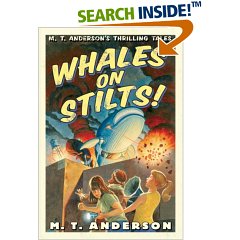
Whales on Stilts!


Whales on Stilts! by M. T. Anderson. Read by Marc Cashman. (Listening Library).

Our Memorial Day Weekend blogstravaganza continues with the fourth (and probably final) installment of a series of reviews of audiobooks for children and teens that I've listened to recently.

Can three twelve-year-olds save the world from a sinister rampage by stilt-walking, red-eyed, laser-wielding whales? Can perfectly ordinary Lily prove she's just as smart and just as exciting as her friends who invent amazing gadgets and fight werewolves? Can M. T. Anderson, the author of Feed, deliver a hilarious parody of the juvenile adventure novel, taking swipes at the Hardy Boys, Nancy Drew, Tom Swift, and Goosebumps in the process? Tune in to Whales on Stilts! and find out. You'll hear Katie say . . .

It all begins in the quiet little town of Pelt, where, "you could get arrested for going five miles over the speed limit. It was that kind of town." Twelve-year-old Lily Gefelty is quiet and observant--so observant in fact that she sees things others miss. For instance, she's the only one who thinks it odd that Larry, her Dad's boss, wears a bag over his head, has rubbery blue skin, periodically douses himself in brine, and gloats openly about taking over the world. When Lily brings up this last particularly troublesome point to her Dad, he reassures her. "People use irony all the time," he says. "They don't always mean what they say."

Lily isn't entirely sure this is just an instance of adult wordplay, so she turns to her two best friends for help. The relentlessly perky Katie Mulligan lives in nearby Horror Hollow and, appropriately enough, finds herself constantly battling vampires, werewolves, zombies, and the like. She's the star of her own "Horror Hollow" series of juvenile novels, and any time she has a brush with some creature of the night, ghostwriters (no pun intended) show up immediately, hoping to get details and fodder for the next adventure.

Lily's other true blue pal is "Jasper Dash, Boy Technonaut," who delivers dialogue and invents gadgets that seem to come from another century ("Dash it all, chums, this sounds a mighty pickle!") His "secret" attachment to a photocopier involves steam pipes, a mule, and a wax cylinder that weighs "only" 200 pounds. His other technological achievements include a flying restaurant where the robot waiters wear bow ties and a rocket car with a top speed of 35 mph. Jasper is also the spokesboy for Gargletine Brand Breakfast Drink, which tastes wretched to everyone but Jasper, so sales of Gargletine and of Jasper's own series of adventure novels have fallen on hard times. Nevertheless, the two famous young people agree to help their less flamboyant friend.

Lily's suspicions about Larry soon prove correct. He's a whale-human hybrid ("His mother was a whale, and his father, a very lonely sailor"), who's planning to unleash an army of supercharged cetaceans on an unsuspecting world, beginning with the nearby town of Decentville, where Lily's grandmother lives. When Katie and Jasper's plans to foil the felonious fishes fail, Lily, inspired by that same grandmother, comes up with her own plan to whip the warlike whales.

(By the way, I know full well that whales aren't fish, but the string of alliterations was just too good to pass up). The whole book is written like that, with over-the-top jokes, one-liners, puns, knowing asides to the reader, and even a spoof of those sanctimonious, unremittingly earnest reader's guides one finds especially in paperback editions today. This one was written by the hopelessly lovelorn and neurotic "Dr. Anne Mowbray-Dixon-Clark." A reader on Amazon.com compared this book to the rapid-fire absurdist satire of Douglas Adams. I'd add a pinch of Monty Python, a dash of Mystery Science Theater 3000, and a smidgen of Roald Dahl. If parents and kids are looking for a fast and funny way to spend about three hours, they should try this book. After all--who wants to argue with a whale on stilts?

Sunday, May 28, 2006

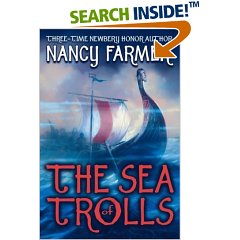
The Sea of Trolls


The Sea of Trolls by Nancy Farmer. Read by Gerard Doyle. (Recorded Books)

Well, howdy, blog fans! This is the third in a series of reviews of children's and young adult audiobooks I've listened to recently that I wanted to share with you.

The Sea of Trolls has much to recommend it. It draws heavily on Norse mythology, an Anglo-Saxon epic, and even a famous nursery rhyme to create an exciting fantasy full of action and adventure, memorable characters, fantastic creatures, and exotic landscapes. This otherwise excellent novel for young people, however, is marred by what seems to be the author's philosophical or theological agenda and some rather heavy-handed editorializing. Christianity and the old pre-Christian religions of Europe are constantly compared, and Christianity nearly always seems to come up short.

In a small coastal village in early medieval England there lives a young boy named Jack. The most exciting events in his everyday life are tending sheep, mucking out the barn, and feeling vaguely jealous of his, pampered younger sister Lucy. All that changes one day when the local poet, wise man, and shaman, known simply as "The Bard," recruits Jack to be his apprentice. The Bard begins teaching Jack the ancient lore of bird and beast, flower and field, tree and leaf, river and ocean. In a clever twist, author Farmer imagines that The Bard is the author of the great Anglo-Saxon epic Beowulf, and thereby hangs the plot. The poem tells the story of how the great warrior Beowulf defeated first the monster Grendel and then Grendel's mother, only to be defeated himself many years later by a terrible dragon.

In Farmer's imaginative departure from this tale, it seems Grendel's mother had a sister, the half-human, half-troll princess Frith, and she's still plenty ticked at The Bard for participating in her sister's downfall. Every night she sends out her spirit, a ghastly malevolent phantom, on a night-mare (literally a monstrous eight-legged horse) to destroy The Bard. When that fails, she sends out a fierce band of Vikings under the command of Olaf One-Brow (so named because his bushy blond eyebrows seem to flow continuously over both eyes) to raid Jack's village. Jack and Lucy are captured by Olaf's men, and The Bard, for some strange reason, is reduced to a babbling idiot, seemingly incapable of coming to Jack's aid. An unusually intelligent crow that Jack names Bold Heart appears out of the fog at a crucial moment, however, to accompany Jack and Lucy on their journey.

Jack and Lucy seem destined for a life of cruel slavery, taunted by Thorgil, the "shield-maiden" or female ward of Olaf, who is just a little older than Jack. When Olaf and his men learn Jack has some skill as a wizard and poet, or skald, however, they treat him with more respect and even a trace of fear. Over time, Jack comes to develop a grudging respect for the Northmen and even the tentative beginnings of a friendship with Olaf. After a long sea voyage, Jack and Lucy arrive in the land of Queen Frith and her husband Ivar the Boneless (so named because of his morbid obesity and his utter inability to stand up to his shrewish wife).

When a bit of Jack's poetry in praise of Frith's hair magically and accidentally makes her hair fall out, the queen is outraged. She commands Jack, Thorgil, and Olaf to go on a quest to Jotunheim, or the land of the trolls, in search of water from Mimir's Well. Water from the well will give Jack the knowledge he needs to restore Frith's hair. If Jack and his companions do not return from the quest before the specified deadline, Lucy will be sacrificed to the goddess Freya. If they return in time, Frith will allow Jack and Lucy to go free.

Jack, Thorgil, and Olaf find Jotunheim, but the trolls and other magical creatures in it are not what they expect. Olaf sacrifices his life on the quest, and Jack and Thorgil must each sacrifice something of great importance to gain water from the well. Along the way, Jack learns Thorgil too, was once a slave, and that her real name is Jill. This discovery, and the quest for water from the well, lead to the creation of a famous nursery rhyme (Can you guess which one?) Jack and Thorgil return from Jotunheim with the cure for Frith, but her own greed and arrogance prove her undoing. Olaf's son agrees to return Jack and Lucy to England, and upon his return, Jack even learns the reason for The Bard's strange illness and the true identity of Bold Heart the crow.

At the beginning of this review I mentioned how this otherwise excellent novel is marred by the author's apparent need to compare Christianity to the ancient pre-Christian religions of Europe (and, I suspect, their modern "New Age" or neo-pagan counterparts). Jack's dour father, the local monks, and other overtly Christian characters, are constantly making grim pronouncements about suffering and the will of God. Jack notices that The Bard does not piously cross himself and intone "Amen," when Jack's father makes one of these sententious statements in the way that Jack's family does. In private, The Bard will even exclaim such things as, "May Odin preserve me from such idiocy!" or, "Thank Freya, you're all right." The Bard is a follower of the old ways.

I might be able to take this with a large grain of salt (Coleridge's willing suspension of disbelief and all that), if it weren't for The Bard's inane prattle about "serving the Life Force" that sounds as if it came from a bad early draft of the script of Star Wars. (The Bard does indeed sound like some kind of medieval Obi-wan Kenobi, and as he ranted on and on during these monologues, I half expected him to whip out a lightsaber and announce dramatically, "Jack! I am your father!") When Jack and Thorgil find Mimir's Well, they also find Yggdrasil, the tree of life from Norse mythology. This is a kind of gigantic, earthbound Noah's Ark that shelters every creature on earth and every possible spiritual destination for those creatures--Asgard and Valhalla for Vikings, heaven for Christians, "and other places I don't even know about," Jack explains. It's cool. It's all life, right? Whatever.

For a Christian, there are so many problems with this line of reasoning I hardly know where to begin. In the first place, Christians are not expected to actively seek out suffering (Even Jesus before his crucifixion prayed, "Father, if it be your will, let this cup pass from me"), When (not if) suffering comes, however, Christians are expected to embrace it as the will of God as Christ did. (He also prayed, "Father, not my will, but yours be done"). Christ, however, did not embrace suffering merely for the sake of suffering, but because it was redemptive. Christ's sufferings accomplished his Father's plan of redemption from sin for the whole world. When followers of Christ suffer in imitation of their master, they are called to join their sufferings to the sufferings of Christ (Col. 1: 24) and participate in the work of their own redemption and the redemption of those around them. What Farmer implies, therefore, about the Christian position on suffering is almost a parody or caricature of the truth.

In the second place, for the Christian, life is not an abstract, impersonal "Force" that somehow exists apart from God to be served or worshipped. It is the result of concrete action by a loving and personal God who created all that is (Col. 1: 13-23). Jesus Christ came that we might have life and have it to the full (Jn. 10: 10) for the God of Christians is "not a God of the dead, but of the living" (Lk. 20: 38), and Christ's resurrection from the dead is conclusive proof of God's power over life and death (1 Cor. 15).

Despite all these Scripture references, I don't consider myself some kind of Bible-thumping Fundamentalist. I am, however, a Christian and a Catholic, and over the last year especially, I have struggled with these questions of suffering, life, death, and resurrection. It pains me to see the Christian position distorted in this way, and some kind of neo-pagan alternative peddled to kids under the guise of fiction. I suppose I can be grateful that Farmer didn't insert additional twaddle about "the sacred feminine" á la Dan Brown.

I am also not a Fundamentalist in the sense that I don't become apoplectic any time I see any reference to magic in fantasy fiction, out of some hysterical fear that it will promote the occult. I've read the Harry Potter books, Jeff Smith's comic book epic Bone, the Shannara books of Terry Brooks, and Robert Jordan's Wheel of Time series, all of which use magic with little or no reference to Christianity. I've also read Tolkien's Lord of the Rings and Lewis's Chronicles of Narnia, which are, of course, solidly Christian in their outlook and present Christian truth indirectly, symbolically, and allegorically through the conventions of fantasy. I've even read Katherine Langrish's juvenile novel Troll Fell, which like Farmer's, draws extensively on Norse mythology, but unlike Farmer, without reference to Christianity. Why Farmer felt motivated to engage in this "comparison shopping," or simple-minded relativism is beyond me, unless she has an axe to grind.

Bottom line: If you can overlook the pseudo-religious, pseudo-mystical piffle in this book, read it (or listen to it) and enjoy. If not, there are lots of better fantasy and adventure titles out there that don't have all the questionable baggage.
Saturday, May 20, 2006

You know you've arrived in the Catholic blogging world when

you're listed in the Catholic Blog Directory.

The Da Vinci Dud


It's happened. The Da Vinci Code movie is out, and it looks like a big, expensive turkey. Deo gratias.

For weeks now, the Catholic blogosphere has been all atwitter over the impending release of The Da Vinci Code. Sony Pictures waited until the last possible second to let critics see the film, and apparently for good reason. The early reviews are in, and for the most part, they are scathing. The consensus seems to be that it's too long, too talky, and too dull, with too little action and too little chemistry between the male and female leads, Tom Hanks and Audrey Tatou. It could still make a gazillion dollars despite lousy reviews because all the shills and morons who loved the book will just have to see the movie. No accounting for taste, eh? I should perhaps add that I myself have neither read the book nor seen the movie and have no plans to do so. The details of both the book and the movie are all over the internet and TV, so I don't have to waste my time actually reading or seeing this drivel.

I don't suppose we should be too surprised that the movie is a dog, given the source material that director Ron Howard had to work with. In an article published two years ago on the Salon website, Laura Miller called the novel:

a cheesy thriller, with all the familiar qualities of the genre at its worst: characters so thin they're practically transparent, ludicrous dialogue, and prose that's 100 percent cliché. Even by conventional thriller standards, the book isn't particularly good; the plot is simply one long chase sequence, and the "good guy who turns out to be evil" is obviously a ringer from the moment he's introduced.


The film is, of course, an adaptation of Dan Brown's execrable novel of the same name that's been at or near the top of the bestseller lists for about three years now. The novel alleges that Jesus was a man, not a god, that Jesus and Mary Magdalene were married and had children, that Jesus wanted Mary Magdalene, not Peter, to be the head of of the "Jesus movement," that the Roman emperor Constantine cooked up the idea of Jesus's divinity at the Council of Nicaea to shore up imperial power, and that the Big Bad Band of Meanies, the Catholic Church, and its goon squad, the organization called Opus Dei, were created essentially to stomp on anybody who disagreed.

A secret society of intrepid souls, however, known as The Priory of Sion, founded in 1099, and headed at one point by Leonardo Da Vinci, preserved The Real Truth about Christianity and tried to communicate The Real Truth by means of ingenious clues hidden in art and architecture. Brown further asserts that all of the charges made in this book are based on fact and can be discovered by any careful scholar--such as himself. However, as Laura Miller points out in that same Salon article, most of Brown's "painstaking research" appears to be cribbed from a nonfiction book called Holy Blood, Holy Grail that made many of the same claims. The authors of Holy Blood, Holy Grail actually sued Dan Brown for plaigarism in England. The judge ruled in Brown's favor, but made it clear he had contempt for both sides.

Brown's little pile of poppycock has sold about 40 million copies worldwide despite the fact that both secular and religious sources (Catholic and Protestant alike) have conclusively demonstrated that all the claims Brown makes about Jesus, the gospels, and the early church are patently false. The Da Vinci Code is hooey, pure and simple--not just hooey, but badly written hooey to boot. Now the badly written hooey has been translated into a badly written movie. One can only hope that once people can see all this idiocy on the screen in glorious living color, they'll stop and wonder how they were stupid enough to fall for it in the first place.

P. S. Hat Tips to Dawn Eden for the link to Rotten Tomatoes.com, Amy Welborn's Amazon.com blog for the link to the Salon article, her regular Open Book blog for the link to the article by Gary M. Burge, and Clayton Emmer for the link to this fine article by Father Joseph Carola, S. J.

Sunday, May 14, 2006

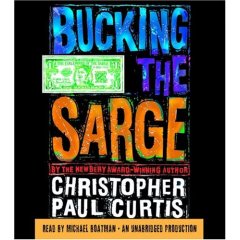
Bucking the Sarge


Bucking the Sarge by Christopher Paul Curtis. Read by Michael Boatman. (Listening Library)

This is the second in a series of audiobook reviews I want to share with you. This book is a witty and ironic look at life in contemporary black America that readers of all races can enjoy. For all the laughs, however, there's a serious message to this book. The message seems to be that a corrupt social and economic system--in many cases created and maintained by black people themselves--allows blacks to oppress and exploit other blacks and deny opportunity to all but the most creative and talented African Americans.

Fifteen-year-old Luther T. Farrell lives amid the urban, post-industrial decline of a predominantly black neighborhood in present day Flint, Michigan. Yet Luther is not the typical African-American teen. He is going for his third consecutive win in his middle school science fair, and his life's ambition is to be "America's Best-Known and Best-Loved Philosopher." Embarrassed by a grade school incident in which he mispronounced the name of Socrates, Luther always precedes his borrowed pearls of wisdom with, "A well-known philosopher--whose name escapes me at the moment--once said . . ."

The only obstacle to victory in the science fair is Shayla "I See Dead People" Patrick, the daughter of Flint's most prosperous African-American undertaker, also a straight A student, and the woman Luther has both loved and hated since they were both four years old. In true Tracy-Hepburn fashion, Luther and Shayla are crazy about each other, but dare not admit it, and can't be in the same room together without sparks flying. Luther carries an unused condom in his wallet in case romance should break out, but it looks as though the condom (named Chauncey because it's come to seem like an old friend) will languish in obscurity.

The only obstacle to Luther going on to college and truly starting his philosophical career is his mother--aka "The Sarge." She's a cold, calculating, avaricious woman, who through iron will and ruthless determination has risen from factory worker to school teacher to slum lord, running loan shark rackets, substandard housing projects, and group homes all over the city. She's bilking the system for all it's worth, charging the government for the cost of steak and shrimp, being reimbursed, buying the cheapest food possible for the group homes, and pocketing the difference. Luther has been the "manager" of one of these group homes since he was thirteen, and the Sarge has no intention of releasing him from servitude.

When Luther realizes that his science project--a report on the illegal use of lead-based paint in low-income housing in Flint--has the potential to bring about his mother's downfall, he feels both regret and fear. Regret because The Sarge is, after all, his mother. Fear because The Sarge is, after all, The Sarge. She's not going to be happy that her own son has blown the whistle on her and destroyed her profitable little empire. When Luther discovers that The Sarge has been siphoning off money intended for his college fund, however, he decides to take action and creates his own unique plan for revenge.

Does the Sarge get what's coming to her? Does Luther admit his true feelings to Shayla and vice versa? Does Chauncey see some action? You'll have to read the book. The author's rather blasé attitude about teen sex, and Luther's desire for revenge against his own mother may seem morally problematic to some listeners, but let's face it--they're realistic. What teenager doesn't think about sex, and with today's oversexed, "just use protection" culture, it's easier than ever to turn teen fantasy into reality. And the Sarge is a witch, after all. She's a corrupt authority figure, and the human sense of justice naturally wants to see corrupt authority brought down.

This story is told with so much humor and with tongue so thoroughly in cheek that it's hard to be truly offended by some morally questionable attitudes. There are memorable minor characters such as Luther's best friend Sparky, Marcel the fence and his pit bull Poofy, the shyster lawyer Dante Orlando Gatty (call 1-800-SUE-EM-ALL), and Darnell Dixon, "one of Flint's leading psychopaths." This book makes you laugh and think, and parents and teens may even want to talk about it after listening. Recommended.

Saturday, May 13, 2006

Feed


Feed by M. T. Anderson. Read by David Aaron Baker. (Listening Library)

This is the first in a series of audiobook reviews I wanted to share. In this young adult novel, Anderson presents a devastating satire and cautionary tale about what could happen when the worst tendencies of today's empty-headed, entertainment-obsessed consumerist popular culture are merged with the worst passive, mind numbing, dumbed-down tendencies of emerging information technologies. Titus and his friends, teens of the not-too-distant future, have lived their entire lives with the hardware and software needed to access the next generation of the internet--known simply as "The Feed"--wired directly into their brains. "Everything that happens, happens on the Feed," Titus says.

Feed subscribers are bombarded with a constant stream of images, sounds, and slogans, all promising them one entertainment experience after another, each more fabulous than the last, and all carefully crafted to persuade them to be avid and mindless consumers. The Feed is the first thing they wake up to in the morning and the last thing they hear before going to sleep at night. Entertainment is even more vacuous than it is today (The most popular "feedcast" is a reality show called "Oh. Wow. Thing."), and information, such as it is, is delivered without depth or context. The Feed can be customized for each individual subscriber, isolating individuals from each other in their own computer-generated worlds. Schools, which exist principally for the purpose of creating not-so-smart shoppers, are run by corporations that can replace live teachers with holograms as a cost-cutting measure.

Using the Feed's computer networks, Titus and his friends can have access to practically any piece of information, but this very ease of access and the flood of information at their virtual fingertips has made them hopelessly intellectually lazy. Slang, slogans, and swear words have taken the place of intelligent discourse, and very nearly, of rational thought. Titus and his friends can barely finish a sentence without resorting to a four-letter word of some kind. Some listeners will find this constant profanity offensive, but I believe this is part of the book's overall message and not merely inserted for shock value. Titus and his friends are so intellectually and spiritually blighted by The Feed that they lack the mental and verbal vocabulary to express themselves without resorting to vulgarity."Everyone's super smart now," Titus says, without a trace of irony.

The Feed's omnipresence has blinded Titus and his friends to the collapse of the world around them. His elders can remember when the last forests died and wild animals took refuge in the cities. The landscape is covered with high rises and shopping malls, each with its own artificial environment. Even furniture is disposable. The air is so polluted that green rain falls from black clouds. Children are created artificially in "conceptionariums," and filet mignon is grown on farms where Titus and his girlfriend can wander surrounded by grotesque mazes of meat. Feed subscribers have begun to develop strange hideous lesions and skin diseases, but with a little careful manipulation from the Feed, the lesions can be presented as the latest fashion accessory. Titus and his friends are dimly aware of the emptiness of their lives, but they have been left so intellectually and spiritually stunted by the Feed that they can scarcely conceive of an alternative.

While on vacation with his friends on the moon, which has become a combination tourist trap and garbage dump, Titus meets Violet, a girl different from anyone he has ever encountered. She has been home schooled, can actually write using pen and paper, wears clothes made of wool rather than plastic, and did not have the Feed installed in her brain until she was seven years old. She resists and confounds The Feed by asking about the most bizarre and unrelated consumer products she can imagine and then not buying any of them, thus preventing The Feed's computers from profiling and categorizing her. A romance between Titus and Violet begins but is not to last. Titus and his friends are attacked by a hacker, forcing them to be temporarily disconnected from the Feed. In most cases this leads only to a few days of anxiety and disorientation, but because Violet had her Feed installed much later in life, the consequences are more severe. Over time, her Feed hardware and software malfunction more and more severely, until finally it becomes clear she will die. Violet's death forces Titus to emerge from his shell of self-absorption and self-indulgence and take up her resistance to The Feed. The last words of the book, the advertising slogan, "Everything must go!" take on a whole new meaning now that Titus has seen the Feed for what it truly is.

The book mirrors perfectly the disgust and revulsion I've come to feel with much of pop culture today, the feelings that led me to give up TV for Lent. I see many of the same feelings expressed by the Catholic bloggers and commentators I read. I don't know M. T. Anderson's religious views, if any, but I suspect he is a secularist, since he doesn't seem to offer any kind of spiritual solution to the soul-killing emptiness of his world. Yet it does seem to me that when both religious and secular critics are pointing out the emptiness and sickness of much of our culture, you know we've got a problem. This outstanding book is a searing indictment of some of the worst aspects of today's society that technology-savvy mall rats and their parents should read before the grim prophecies of this book come true. As Titus might say, "Unit! Feed is like . . . meg brag!"

Heard Any Good Books Lately?

If anybody besides me reads this blog (a doubtful prospect, since I've gotten a grand total of ONE non-spam comment), they know that I love audiobooks. They're one step closer to pure storytelling since all the listener has to convey character, action, setting, and mood are the reader's voice and his own imagination. I also like them for the practical reason that you can listen to them while doing other things: riding in the car, eating dinner, doing the dishes, getting dressed, etc.

During my TV-free Lent I listened to two audiobooks for teens that I thought were really good--one quite extraordinary in fact. I often think that the stuff being published for kids and teens today is far more interesting than the stuff being published for adults. The novelist Martin Amis said as much in an article I read about ten years ago when I was still in library school. He complained that there was far too much self-consciously literary fiction being written in a needlessly artsy style in which dull little characters struggled through their dull little lives, wrestled with their existential angst, and wondered about The Meaning Of It All. He argued that if a writer was interested solely in creating good characters and telling a good story he would almost have to write for children. Children don't care about exquisitely crafted prose, pretentious literary allusions, or characters struggling to find Meaning in their lives, he said. (Perhaps teens do want to find meaning, and in fact I think that's the subject of one of the books I want to review below, but I think the substance of his argument holds true). What children and teens want most are solid, believable, interesting characters and compelling stories. Speaking only for myself I can say that many adults want them too. With that in mind, I want to devote the next several posts to the following audiobooks I've listened to recently.