Saturday, July 20, 2013
Please Pray for Thomas Peters
Dear friends and blog readers, in your charity please pray for Thomas Peters, author of the former American Papist blog that's now part of the CatholicVote.org website. Thomas was critically injured in a swimming accident earlier this week. I don't know Thomas personally, but he is a good friend of my Facebook friend William "Billy Newton, author of Blog of the Courtier. By all accounts, Thomas is a fine and dedicated young Catholic who has done much good work writing and speaking on behalf of the Church. Such is the power of the internet and social media that we can feel a personal connection to people we have never met. Thomas's friends and family have set up the Thomas Peters Recovery blog to keep friends, family, and well-wishers posted on Thomas's condition. There are signs that he is making progress, but no doubt his recovery will be long and difficult. What makes this situation especially tragic is that Thomas was married just a few short weeks ago. Please pray for his family and especially for his wife Natalie, that they receive all the graces they will surely need to cope with this unexpected trial.


Wednesday, June 19, 2013
Housecleaning

Wednesday, June 12, 2013
Dicas Latinae? Pars secunda (Do you speak Latin? Second part)

In the previous post, I described (at somewhat greater length than I anticipated) how I became interested in and curious about what is variously called the Tridentine Rite, the Traditional Latin Mass, or the Extraordinary Form of the Roman Rite. Now I'd like to tell you a little bit about my first impressions about my first ever participation in this form of the Mass last Sunday at a local parish. This was an authorized celebration of the Latin form of the Mass promulgated in the 1962 Missal and in accordance with Pope Benedict XVI's motu proprio Summorum pontificum. This was not another form of the Latin Mass offered by the Society of St. Pius X (SSPX) or other schismatic groups.
I was almost an hour early for this liturgy because I had to use the city of Charlotte's Special Transportation Service (STS) to get there and had to be ready on their schedule. Another Mass in the Ordinary Form (English) was still going on, so while I waited for this Mass to end, I chatted with some other people who were already starting to gather outside. When the first Mass ended, I also spoke with some of the people attending it. To a person, they all spoke very highly of the church's pastor and complimented him and the church's staff for their efforts to celebrate truly beautiful and reverent liturgies. I spoke with the priest himself who assured me that "We try to do things a little differently here." Then we went inside.
I was immediately struck by the physical appearance of the church where this Mass was being celebrated. I don't know anything about architecture, but if I had to take a stab at describing the architectural style, I would call it neoclassical, rather than modernist; if by "neoclassical" one means balanced and well-proportioned and and by "modernist" one means ugly and full of bizarre shapes and strange angles, as with some newer Catholic churches I have visited. I would describe the interior as very traditional and very much what one might expect the interior of an older Catholic church to look like: a choir loft and a large marble baptismal font in the rear, pews of dark wood, large stained glass windows, large statues of the saints and Stations of the Cross prominently displayed on the walls, crucifix of dark wood, and a large, ornate, centrally positioned Tabernacle, prominently on display. This is in marked contrast to some more recently built churches I have visited where it seemed one needed a microscope to find the Stations of the Cross and a compass and a guide dog to find the Tabernacle. At this tradition-friendly parish there was also a large, old-fashioned elaborately carved wooden ambo that the celebrant had to reach by climbing up steps. I had only seen ambos like these in photographs of older European churches and cathedrals. (I wasn't trying to be flippant, but in my head I immediately dubbed this the "Ambo What Am.") If I had to choose a parish solely on the basis of aesthetics or appearance, I would choose this parish in a heartbeat.
Another thing that struck me was the pervasive (and I must say refreshing) atmosphere of quiet. Outside, on the grounds of the church and in the vestibule parishioners were talking with their friends as one might before or after any Mass, but once one went inside the sanctuary there was an air of quiet, contemplation, and anticipation. Something special was about to happen. People talked in whispers, if at all. Mass-goers trickled in by twos and threes, until, I would guess, the church was about half full. Critics of the Latin Mass frequently like to portray its supporters and defenders as cranks, malcontents, and old fogeys who are hopelessly nostalgic for the nonexistent "good ol' days;" but from what I could see at this Mass, there was a wide range of ages in attendance, from families with young children to retirees and the elderly. Women are still strongly encouraged (but not required) to wear a head covering during the celebration of this form of the Mass, and there are few things cuter in this world than the sight of a girl under six wearing a chapel veil.
Mass began with the ringing of a bell, the chanting of an entrance antiphon, and a procession up the center aisle, much like in the Ordinary Form. So far so good. I knew the entire liturgy, except for the homily, and perhaps the readings, would be in Latin (Duh!) I knew the priest would stand ad orientam (literally, "to the East," facing the direction from which the sun rises, and symbolically the direction from which the Son of God rose on Easter morning. I knew the servers would answer on behalf of the congregation. What I perhaps knew but did not fully realize, was that I would not be able to hear what the priest and servers said. I suppose that without thinking about it, I had come expecting that the priest and servers would chant the prayers and responses in a voice loud enough to be audible, and I could follow along in my paperback missal which has the Latin text on the left hand page and the English on the right. This was not the case. Most of the prayers and responses were inaudible to me, and I presume to the rest of the congregation, except perhaps the people sitting right up front. This made it extremely difficult for me to follow the prayers of the Mass, and I eventually gave up trying and simply let myself experience it.
The only times I could really hear something were when the priest would turn to the congregation and chant Oremus (let us pray) followed by a prayer; Dominus vobiscum (the Lord be with you); or Ite missa est (the Mass is ended). In the latter two cases, I did know that the proper responses were et cum spiritu tuo (and with your spirit) and Deo gratias (Thanks be to God) respectively. Chants and hymns, delivered by a very fine schola cantorum, floated out of the choir loft at the appropriate points in the liturgy, seemingly as if by magic (or perhaps I should say as if delivered by invisible angels). I suddenly realized the advantages of this arrangement over the usual practice in newer churches of having musicians and choir members at the front of the church. With a choir loft at the back, Mass-goers can hear and appreciate the music of the liturgy without being distracted by seeing musicians and choir members bustling about with instruments and hymnals and whatnot.
The Mass itself was followed by more prayers and the singing of the Salve Regina (Hail, Holy Queen), which happens to be one of the few Latin hymns I know. I joined in and later received a couple of compliments on my voice, which was flattering. Still trying to process this brand new experience, I introduced myself and shared my first impressions with my fellow Mass-goers. I quickly noticed that many defenders of the Latin Mass are passionate and almost fanatical about their favorite subject. One very earnest, well-meaning gentleman was prepared to tell me at great length and in great detail why the Mass in Latin was better than the Mass in English. When he began to mutter darkly about how "they" didn't want the Church to celebrate the Mass in Latin, I gently cut him off, fearing I was in for a paranoid rant.
Which brings me to the dark side of the Traditionalist movement. I've noticed when visiting Traditionalist websites and reading the comments of self-identified Traditionalists on Catholic blogs I read, that there are very unhealthy, uncharitable, and un-Christian strains of pride, arrogance, and paranoia running through much Traditionalist rhetoric. It is one thing to say that you wish to preserve and perpetuate the older traditions, devotions and forms of worship in the Catholic Church because they are ancient, venerable, beautiful, meaningful and great aids to holiness. There you have my sympathy. It is one thing to acknowledge and point out that since the reforms of the liturgy in the 1960s and '70s, on occasion there have been gross liturgical abuses committed in the name of "the spirit of Vatican II," or some other such foolishness. There you also have my sympathy.
It is quite another thing to let that zeal for the ancient traditions of the Church harden or transform into pride and arrogance and come to believe that YOU and and YOUR PARTICULAR GROUP of Catholics are the only REAL Catholics because YOU and YOUR GROUP are the only ones who celebrate Mass "the right way" (i. e. your group's way, as opposed to the way defined by the Universal Church—either the Ordinary Form or the Extraordinary Form set forth in the 1962 Missal). It is another thing entirely to heap scorn and contempt on your fellow Catholics who might not share your zeal and affection for the Traditional Latin Mass, and to insinuate or claim outright that they are not really Catholics because of it.
Finally, it is completely unacceptable to claim that any Pope who promulgates or accepts the reformed, vernacular liturgy is somehow not the real Pope, as the "sedevacantists" do. Either the Catholic Church was founded by Jesus Christ and built upon the Rock of Peter, or it is not. Either the man chosen by the College of Cardinals is the legitimate successor of Peter or he is not. If the Catholic Church is the Church of Jesus Christ, and the Pope is the successor of Peter, than it is the radical Traditionalist and sedevacantist who has strayed from the truth, not vice versa. If the Catholic Church is not the church founded by Christ and built upon Peter and his successors, I submit that the radical traditionalists, who claim to love the Church so much, are calling Jesus Christ, the founder and head of the Church, a liar.
So much for my own rant. Will I go back? I don't know. Everyone I talked to acknowledged that the Extraordinary Form takes some getting used to, and may take a while to learn to appreciate. They urged me to keep coming back and keep giving it a try. When I pointed out that most of the prayers are inaudible, one gentleman tried to persuade me that this is actually an advantage. One can either follow along in the missal or pray silently on one's own knowing that the sacrifice of Christ is being re-presented, he said.
We'll see. I want real truth. I want real beauty. I want real transcendence. I believe these things can be found in the Catholic Church, and I believe they can be found in the Mass. It just might take some work to find them.
Monday, June 10, 2013
Dicas Latinae? Prima pars. (Do you speak Latin? First part)
Dicas Latinae? (Do you speak Latin?) Fortasse. (Maybe).

Yesterday, I attended my first ever Mass in the Extraordinary Form (aka Traditional Latin Mass, Tridentine Mass) at a parish here in Charlotte and lived to tell the tale. It was new. It was . . . different.
First, a few words of explanation. I was born in 1963, smack dab in the middle of the Second Vatican Council, and by the time I was coming along, the reforms of the liturgy had been completely implemented and the Mass was entirely in English with the priest facing the people (versus populo, I believe it's called) and the liturgy structured as a dialogue between the priest and the people. I knew, of course, that there was an older Latin form of the Mass, but I didn't really know much about it. When I began blogging on Catholic topics in 2005, I quickly noticed that there seemed to be no faster or better way to start a virtual fistfight among Catholics on the internet than to venture an opinion, pro or con (See there, I used Latin!), on the Latin Mass.
Advocates said it was beautiful, mystical, ancient, and holy, and the de facto (See there, I used Latin again) suppression of the Latin Mass in favor of Mass in the vernacular after Vatican II was one of the worst things to ever happen to the Church. The virtual disappearance of the Latin Mass after Vatican II was alleged to be the root cause of plummeting Mass attendance and nosediving priestly vocations. (I always thought this was an example of the post hoc, ergo propter hoc fallacy, but no matter). Why on earth did the Church decide to change? Some advocates for the traditional Latin Mass claim that Dark Sinister Liberal Forces [TM] both inside and outside the Church, ranging from closet Protestants to Freemasons and neopagans deliberately suppressed the older form of the Mass and implemented their version of the liturgy for the purpose of destroying the Church. Some of these same advocates denounce even the motu proprio of Pope Benedict XVI, Summorum pontificum, authorizing a wider use of the Latin Mass in the 1962 Missal, as a mere piece of camouflage designed to draw gullible traditionalists into a carefully concealed and orchestrated modernist agenda.They claim that the Mass promulgated in the 1962 Missal is a "bastardized" form of the authentic Traditional Latin Mass.
Critics of the Latin Mass, on the other hand, usually argue that this form of the Mass is incomprehensible, in a language most people cannot understand or even hear, because the priest says most of the prayers with his back to the congregation and in a low, even inaudible voice. The people cannot see what takes place on the altar. Furthermore, critics claim, this Mass is elitist and exclusive because the altar boys (girls and women are not permitted to serve on the altar in the Extraordinary Form) answer on behalf of the congregation. The people are not permitted to speak for themselves except at certain times and are reduced to passive spectators.
For most of my life as a Catholic I would have put myself squarely in the modernist and contemporary camp. I took courses in church history in college and loved the sound of Latin words and phrases, but I couldn't imagine not being able to hear, understand, and verbally pray the prayers of the Mass. I couldn't imagine not being able to see what took place on the altar. I loved the music of the St. Louis Jesuits and the "folk Mass" movement of the 1960s and '70s. I had a moment of revelation, however, when I first heard——really heard——sacred polyphonic music, first on a public radio classical music show, and then via Limewire and iTunes. I can recall stopping what I was doing just to listen, absolutely transfixed by the beauty of the blended voices. When I realized this was music for the liturgy, I was astounded. Why had I not heard this before? Why had every Catholic not heard this before? I wanted to hear more. After listening to the music of Tallis, Byrd, Palestrina, and Victoria, I concluded that the "folk" music I had loved so much when I was younger now seemed insufferably shallow and cheesy by comparison. More recent compositions, that sounded as if they belonged at a Celine Dion concert, and "praise and worship" style songs played on keyboards, electric guitars and (shudder) drums were even worse. When I realized that all this glorious music I had come to love was composed for the older form of the Mass, I concluded this older form, so often derided, disparaged, and dismissed, must have something going for it.
I began to study and try to learn more. I learned that the Second Vatican Council did not forbid the Latin Mass. Rather, it permitted the Mass in the vernacular. I learned that in the older form of the Mass, the priest does not stand "with his back to the congregation." He stands facing the same direction as the people. Since the priest offers the Mass before God on behalf of the people, it makes perfect sense that he would face the same direction they do. I ordered a paperback Latin-English missal and a copy of Let's Read Latin, a short introductory course in ecclesiastical Latin created by the late Ralph McInerny, author of the Father Dowling novels. I set out trying to learn Church Latin, but it's tougher than it looks, and I couldn't keep up my enthusiasm when I knew that there wasn't a a parish near me that offered the Latin Mass . . .
Until I came to Charlotte, that is. Facebook friend Katrina Fernandez, author of The Crescat blog, recommended I try her parish, which is very tradition-friendly. When I saw that the parish regularly offered Mass in the Extraordinary Form, I decided to go and see what all the fuss was about. In my next post, I'll tell you what I found.

Yesterday, I attended my first ever Mass in the Extraordinary Form (aka Traditional Latin Mass, Tridentine Mass) at a parish here in Charlotte and lived to tell the tale. It was new. It was . . . different.
First, a few words of explanation. I was born in 1963, smack dab in the middle of the Second Vatican Council, and by the time I was coming along, the reforms of the liturgy had been completely implemented and the Mass was entirely in English with the priest facing the people (versus populo, I believe it's called) and the liturgy structured as a dialogue between the priest and the people. I knew, of course, that there was an older Latin form of the Mass, but I didn't really know much about it. When I began blogging on Catholic topics in 2005, I quickly noticed that there seemed to be no faster or better way to start a virtual fistfight among Catholics on the internet than to venture an opinion, pro or con (See there, I used Latin!), on the Latin Mass.
Advocates said it was beautiful, mystical, ancient, and holy, and the de facto (See there, I used Latin again) suppression of the Latin Mass in favor of Mass in the vernacular after Vatican II was one of the worst things to ever happen to the Church. The virtual disappearance of the Latin Mass after Vatican II was alleged to be the root cause of plummeting Mass attendance and nosediving priestly vocations. (I always thought this was an example of the post hoc, ergo propter hoc fallacy, but no matter). Why on earth did the Church decide to change? Some advocates for the traditional Latin Mass claim that Dark Sinister Liberal Forces [TM] both inside and outside the Church, ranging from closet Protestants to Freemasons and neopagans deliberately suppressed the older form of the Mass and implemented their version of the liturgy for the purpose of destroying the Church. Some of these same advocates denounce even the motu proprio of Pope Benedict XVI, Summorum pontificum, authorizing a wider use of the Latin Mass in the 1962 Missal, as a mere piece of camouflage designed to draw gullible traditionalists into a carefully concealed and orchestrated modernist agenda.They claim that the Mass promulgated in the 1962 Missal is a "bastardized" form of the authentic Traditional Latin Mass.
Critics of the Latin Mass, on the other hand, usually argue that this form of the Mass is incomprehensible, in a language most people cannot understand or even hear, because the priest says most of the prayers with his back to the congregation and in a low, even inaudible voice. The people cannot see what takes place on the altar. Furthermore, critics claim, this Mass is elitist and exclusive because the altar boys (girls and women are not permitted to serve on the altar in the Extraordinary Form) answer on behalf of the congregation. The people are not permitted to speak for themselves except at certain times and are reduced to passive spectators.
For most of my life as a Catholic I would have put myself squarely in the modernist and contemporary camp. I took courses in church history in college and loved the sound of Latin words and phrases, but I couldn't imagine not being able to hear, understand, and verbally pray the prayers of the Mass. I couldn't imagine not being able to see what took place on the altar. I loved the music of the St. Louis Jesuits and the "folk Mass" movement of the 1960s and '70s. I had a moment of revelation, however, when I first heard——really heard——sacred polyphonic music, first on a public radio classical music show, and then via Limewire and iTunes. I can recall stopping what I was doing just to listen, absolutely transfixed by the beauty of the blended voices. When I realized this was music for the liturgy, I was astounded. Why had I not heard this before? Why had every Catholic not heard this before? I wanted to hear more. After listening to the music of Tallis, Byrd, Palestrina, and Victoria, I concluded that the "folk" music I had loved so much when I was younger now seemed insufferably shallow and cheesy by comparison. More recent compositions, that sounded as if they belonged at a Celine Dion concert, and "praise and worship" style songs played on keyboards, electric guitars and (shudder) drums were even worse. When I realized that all this glorious music I had come to love was composed for the older form of the Mass, I concluded this older form, so often derided, disparaged, and dismissed, must have something going for it.
I began to study and try to learn more. I learned that the Second Vatican Council did not forbid the Latin Mass. Rather, it permitted the Mass in the vernacular. I learned that in the older form of the Mass, the priest does not stand "with his back to the congregation." He stands facing the same direction as the people. Since the priest offers the Mass before God on behalf of the people, it makes perfect sense that he would face the same direction they do. I ordered a paperback Latin-English missal and a copy of Let's Read Latin, a short introductory course in ecclesiastical Latin created by the late Ralph McInerny, author of the Father Dowling novels. I set out trying to learn Church Latin, but it's tougher than it looks, and I couldn't keep up my enthusiasm when I knew that there wasn't a a parish near me that offered the Latin Mass . . .
Until I came to Charlotte, that is. Facebook friend Katrina Fernandez, author of The Crescat blog, recommended I try her parish, which is very tradition-friendly. When I saw that the parish regularly offered Mass in the Extraordinary Form, I decided to go and see what all the fuss was about. In my next post, I'll tell you what I found.
Saturday, June 01, 2013
Greetings from Charlotte!
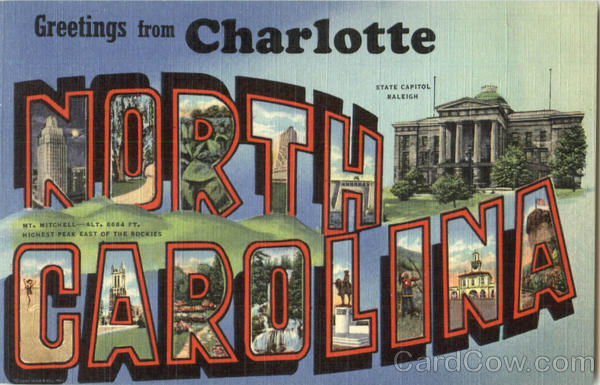
Greetings from the new worldwide, international headquarters of "It's All Straw," beautiful Charlotte, North Carolina!
You may remember from my last post, gentle reader (if I have any readers left), that I was just days away from moving to the Queen City. The great day did indeed arrive, and the move went off largely without a hitch. With the help of brothers, a sister, a sister-in-law, and a horse trailer, I moved into my new new abode, which is positively palatial compared to my old digs. I sat in the living room in astonishment, just watching everyone else bustle in and out with boxes, bags, furniture, and whatnot, and murmuring, "Oh. My. God." every few minutes. It seemed too wonderful to be real. The condominium complex where I live is beautifully maintained, and my new neighbors have been kind and welcoming. There are still days I find myself thinking, "Wow! I get to live here!"
The rooms are open and airy with large windows to let in plenty of sunlight, which is a real mood booster. I have a sun room, and my sister says she has a case of sun room envy. For the first time in my life, I have a garage! (I don't have a car, but I have a garage). There is some discussion among my brothers as to the possibility of turning this space into some sort of man cave. Stay tuned for further developments.
Navigating the health care and social service bureaucracy took longer than I would have liked, but I now have an attendant/aide to help me for a few hours every weekday with what I call the three H's: Health, Hygiene, and Housekeeping. I don't need as much help as some other people with disabilities I know, but having a helping hand with certain tasks just makes life a whole lot easier. I have a city bus pass and a transit ID, and I'm learning how to use the city's public transit system to get where I want and need to go. Now it's time to develop a daily routine. Little by little I'm beginning to feel at home.
I've visited a couple of different parishes in the greater Charlotte area, looking for a spiritual home. For the first time in my life I have a real choice of parishes to attend. When I made contact with one parish to ask about transportation to Mass, I got a call back from the president of the parish's praesidium of the Legion of Mary. I was very active in the Legion in my old parish in South Carolina, so a chance to chat with a fellow Legionary was a little taste of home. Next week, I think I'd like to visit the local parish that celebrates Mass in the Extraordinary Form (aka the Tridentine Rite or the Traditional Latin Mass). Although I've come to love sacred polyphony and appreciate Gregorian Chant, I've never actually attended a Traditional Latin Mass and would really like to have the experience. The older I get, the friendlier I am becoming to tradition.
Even as I'm sitting here thinking about exploring and recovering the Catholic Church's past, I'm excited about the future. Every day feels like a bit of an adventure with new possibilities. As I told a friend recently, I feel a bit like the country mouse from Aesop's fables, suddenly whisked away from a pokey, pedestrian small town to the big, bustling city with all its delights (and frustrations). Unlike the mouse in the fable, however, I don't think I'll be headed back to the country any time soon. The city is beginning to feel like just the right place for me.
Wednesday, March 06, 2013
Relocation
After the home invasion I described in the previous post, my family and I were very concerned about my physical safety. I didn't really want to stay in a place where my life could be at risk, and my family certainly didn't want me to be here. What to do?
My brother Allen, God Bless Him, boldly stepped up with a solution. He took out a loan to buy a condo unit in Charlotte, NC that has already been modified to accommodate a person with a disability. His offer to buy the property was immediately accepted, and the pre-move planning and preparations have gone remarkably well and smoothly, to me a sure sign of God's providence at work. Now only a few days remain before The Big Move. My old apartment is littered with bags, boxes, and whatnot. I don't know how we will get it all into the truck and trailer we'll be using, but I guess we'll figure something out. I suspect it will look something like this:

My brother Allen, God Bless Him, boldly stepped up with a solution. He took out a loan to buy a condo unit in Charlotte, NC that has already been modified to accommodate a person with a disability. His offer to buy the property was immediately accepted, and the pre-move planning and preparations have gone remarkably well and smoothly, to me a sure sign of God's providence at work. Now only a few days remain before The Big Move. My old apartment is littered with bags, boxes, and whatnot. I don't know how we will get it all into the truck and trailer we'll be using, but I guess we'll figure something out. I suspect it will look something like this:

I'm excited, nervous, and a little sad to be leaving the people and the community that I've lived in for nearly a dozen years, but it's plainly time to go. The community where I'm living now has been dying a slow and painful death for years, and by moving to Charlotte, I'll be closer to family and a new resident of one of the fastest growing metropolitan areas in the country with better housing, better medical care, better transportation, better cultural opportunities, and overall better quality of life. Change and striking out into the unknown can be scary, but I'm choosing to look upon this experience as an adventure. As Bilbo Baggins says in The Lord of the Rings, "I'm quite ready for another adventure." See you on the other side!
Wednesday, February 13, 2013
Invasion
 |
| "St. Michael the Archangel, defend us in battle" |
OK, so maybe that was a trifle flippant for an opening, but a lot has been going on around here, and not all of it good. I didn't know how to begin.
On the evening of January 12, I became a victim of a violent crime—a home invasion to be precise. A little before 8 pm, I heard a loud and insistent knocking at the door. Despite my protestations that I was coming to answer it, the knocking continued. I opened the door without thinking, and there before me stood a young African-American man I had never seen before. He was dressed all in black and wearing a Balaclava style cap that has a hole for the face and a mask that can be pulled up to shield the face against the cold. He made a pretense of asking if this was “Billy’s” apartment, and when I told him repeatedly that it wasn't, and when I told him I lived here, he pulled a gun and forced his way in. He asked me repeatedly for cash, drugs, and jewelry, and I told him repeatedly that I didn't have any of those things in the house. I told him that he was welcome to whatever else he wanted—computer, stereo, TV, wallet, etc.
He took my cell
phone and my debit/ATM card and demanded the PIN number, which I gave him. He
gave the card to his partner outside who took it to the wrong bank. The second
guy came back a few minutes later without any money. The first guy then gagged
me with socks and tied me up with cords and duct tape I had in the house and
then drove me into the bathroom in my electric wheelchair. He said his buddy was
waiting in the living room, and if I made any move to escape or call for help,
the buddy would come and shoot me. The first guy said he would go “to the store”
and try to use my card. If I gave him a false PIN number, he said he would kill
me. I waited for what seemed like an eternity, but I didn't hear anything from
the living room, so I gambled that either there was no second guy in the living
room, or if there was, he would come and shoot me and my life would be over. I
told Jesus and Mary that I was very sorry for any bad thing I had ever done, and
that if my life ended that night I hoped they’d cut me some slack and let me
into heaven. :)
I wriggled until I got the
gag loose and wriggled some more until I was able to reach the lifeline beeper
around my neck. I hit the beeper and the alarm sounded and a few seconds later,
an operator came on the line. I had to yell three times before I could make the
person understand that I was being robbed. The odd thing was, I’ll swear the
robber came back at this point and said something like, “How could you do me
like that, man? I could only go to one bank,” and left. The operator called the
cops, who arrived a few minutes later, asked me many questions, and tried to
gather fingerprint and DNA evidence. I spent the night with friends of mine who
are gun owners and know how to use them. I did not want to be alone. The next
day I called my bank and reported the card stolen.
Since then, my brother Allen, who is a compliance officer at a credit union
and knowledgeable about bank fraud, has visited me. He and I went online and
found the addresses of the ATMs where the thief or thieves stopped and tried to
get cash. They stopped at ATMs in local convenience stores between Marion, where
I live, and Mullins, another small community about 7 miles from here. I turned
this information over to the police, who followed up on it. I've since been
informed that the owner of one of the convenience stores was able to identify
one of the suspects from security camera footage at the ATM. I've also been told by the police that this suspect is wanted on a previous parole violation and is now believed to be in Columbia, the state capital. I hope this means that warrants and bulletins for this man are out all over the state, and that any cop he encounters will know to pick him up. The detective investigating my case has promised to call me when an arrest is made. I'm still waiting.
This was the most terrifying experience of my life. The guy threatened to kill me several times, and for a few days afterward I had a small bump on my forehead where he tapped me with his gun to prove he was serious. For a day or two after the incident, every time the phone rang or my e-mail jingled I nearly jumped out of my skin. My front door is double locked, and I will not open it unless I know who’s on the other side.
Despite this ordeal, I believe God was very good to me during the robbery and its aftermath. People have complimented me on my courage and presence of mind, but I attribute my survival solely to the Grace of God and the intercession of our Blessed Mother. Although I'm still trying to process what happened and still thinking about the incident more than I would like, I have thus far been spared flashbacks, nightmares, or any other signs of post-traumatic stress. I have made a point of praying for my attacker. Although there have been moments I've fantasized about revenge or what I might have done if I'd been an action movie hero armed with a gun myself, I don't really hate this person. I pity him. How could one human being become so morally and spiritually warped that he would think assaulting a middle-aged white dude in a wheelchair and stealing a measly few hundred bucks and a cell phone was a good idea?
I want this man brought to justice under the law, but I also pray he will have the opportunity to realize what he has done, repent of it, and turn his life around. Otherwise, there is a good chance he will wind up dying a violent death, either at the hands of the police or some other bigger, meaner thug with a bigger and meaner gun than he has, and with even less regard for human life. If that happens, he will face a justice more severe than anything a human court can dish out.
Monday, December 31, 2012
Auld Lang Syne x3!
For those of you who'll be ringing in the New Year at midnight tonight (Please don't drink too much, or if you do, please don't drink and drive), here's the version of "Auld Lang Syne" that you're most likely to hear tonight, as performed by Guy Lombardo and his Royal Canadians:
I don't know about you, but that melody and arrangement have always seemed way too sappy and schmaltzy for my taste. Did you know that there are at least two other melodies to which the song can be sung? (Both of which sound better to my ears than the previous one). The original words are in Scots dialect and were collected or composed, at least in part, by the Scottish poet Robert Burns (1759-1796) for a compilation of Scottish folk music called The Scots Musical Museum. Quoth Wikipedia:
Here is an alternate version of the song, with a different melody, performed by the Scottish folk group The Tannahill Weavers:
Here is yet another version of the song with another melody, as sung by the Scottish singer Madelaine Cave and illustrated by some lovely Scottish landscapes:
Most people sing this song without having the slightest idea what it is really about. It is in reality a conversation between old friends (or perhaps old lovers, since the expression, "My Jo," is a term of endearment similar to "my love" or "my darling") reflecting on how much they have been through together. Circumstances have been difficult, and they have been separated, but they survived, thanks to their shared affection, shared experiences, and shared memories. They'll survive whatever the future may hold thanks to that same bond of affection and (being Scots) the occasional good stiff drink! Loosely translated from Scots, the chorus says, "We'll take a cup of kindness yet, for old times sake." A good thought to remember as we bid farewell to 2012 and say hello to 2013, yes?
Whichever of the three versions you prefer, I wish you, my readers and friends, the very best for the remainder of this Christmas season and for the new year 2013. To use another Scots expression, "Lang may yer lum reek," (literally, "Long may your chimney smoke," i.e, Long life to you!)
I don't know about you, but that melody and arrangement have always seemed way too sappy and schmaltzy for my taste. Did you know that there are at least two other melodies to which the song can be sung? (Both of which sound better to my ears than the previous one). The original words are in Scots dialect and were collected or composed, at least in part, by the Scottish poet Robert Burns (1759-1796) for a compilation of Scottish folk music called The Scots Musical Museum. Quoth Wikipedia:
Robert Burns sent a copy of the original song to the Scots Musical Museum with the remark, "The following song, an old song, of the olden times, and which has never been in print, nor even in manuscript until I took it down from an old man." Some of the lyrics were indeed "collected" rather than composed by the poet; the ballad "Old Long Syne" printed in 1711 by James Watson shows considerable similarity in the first verse and the chorus to Burns' later poem, and is almost certainly derived from the same "old song".
Should Old Acquaintance be forgot,
and never thought upon;
The flames of Love extinguished,
and fully past and gone:
Is thy sweet Heart now grown so cold,
that loving Breast of thine;
That thou canst never once reflect
On Old long syne.
CHORUS:
On Old long syne my Jo,
On Old long syne,
That thou canst never once reflect,
On Old long syne.
It is a fair supposition to attribute the rest of the poem to Burns himself.
There is some doubt as to whether the melody used today is the same one Burns originally intended, but it is widely used in Scotland and in the rest of the world.
Here is an alternate version of the song, with a different melody, performed by the Scottish folk group The Tannahill Weavers:
Here is yet another version of the song with another melody, as sung by the Scottish singer Madelaine Cave and illustrated by some lovely Scottish landscapes:
Most people sing this song without having the slightest idea what it is really about. It is in reality a conversation between old friends (or perhaps old lovers, since the expression, "My Jo," is a term of endearment similar to "my love" or "my darling") reflecting on how much they have been through together. Circumstances have been difficult, and they have been separated, but they survived, thanks to their shared affection, shared experiences, and shared memories. They'll survive whatever the future may hold thanks to that same bond of affection and (being Scots) the occasional good stiff drink! Loosely translated from Scots, the chorus says, "We'll take a cup of kindness yet, for old times sake." A good thought to remember as we bid farewell to 2012 and say hello to 2013, yes?
Whichever of the three versions you prefer, I wish you, my readers and friends, the very best for the remainder of this Christmas season and for the new year 2013. To use another Scots expression, "Lang may yer lum reek," (literally, "Long may your chimney smoke," i.e, Long life to you!)
Thursday, November 15, 2012
Skyfall: A Catholic Movie?
Here's Father Robert Barron, host of the popular "Word on Fire" YouTube video series with a commentary on the surprising Catholic elements and connections in the new James Bond movie Skyfall. Caution: Includes spoilers.
Here's the trailer for Skyfall.
Here's the trailer for Skyfall.
Wednesday, September 12, 2012
Eleven Years and One Day Ago . . .

As genealogists, we all know that history is important; but so often we tend to focus on history on a small scale. What happened in our family? Our town? Our county? The doings of the great and powerful, events on the world stage that get written up in history books, sometimes seem to be of interest only insofar as they affect our ancestors. There are other times, however, when history in the largest sense reaches out and affects everyone of us. We can recall exactly where we were and exactly what we were doing when we heard that some great and terrible event had occurred. For people of my parents' generation, it was the bombing of Pearl Harbor in 1941; for my older brothers and sisters, it's probably the assassinations of John and Robert Kennedy in the 1960s; for me, it's 9/11.
On September 11, 2001, I had just gotten to work at my still new job as the Technical Services Librarian (cataloger) for a small county-run public library system in rural South Carolina. The weather was sunny and mild, much like it is today. At first, there was absolutely no hint that anything was wrong.
I had just stepped into our tiny break room to pour myself a cup of coffee before beginning the day's cataloging when the phone rang. My boss Salley, the library director, was calling from her home in the nearest city, about 45 minutes away, to tell Margaret, her administrative assistant, that a plane had just crashed into the World Trade Center in New York. It was only later that I learned that Salley had a daughter who was living and working in New York and trying to make it as an actress. No wonder it was so personal to her.
At first I thought this was perhaps just a tragic accident; perhaps the pilot of a small plane had become lost or disoriented or had suffered some catastrophic instrument failure. As Margaret rushed into the break room to turn on the TV and details of the crash began to emerge, it became clear that this was no accident. This was a large commercial jetliner. Minutes later came the second crash. As I watched in horror and disbelief, my mind reeling from the implications of the first two collisions, there came the news that a third plane had crashed into the Pentagon.
I tried to stay calm and go about my daily routine, but it didn't do much good. My concentration was gone. I think I managed to catalog only two books that day. Every few minutes I would stop and sneak back into the break room trying to get more news. When I heard that the authorities had grounded all air traffic and effectively sealed off New York and Washington, D. C., I e-mailed two dear friends of mine who live in the greater Washington area to make sure they were all right. One of them, a professor at Gallaudet University, a school that serves the deaf, wrote back, "Please pray for our students. Many of them are scared and don't understand what's happening." They were not alone in that feeling. I e-mailed my nephew who is a federal employee. Suddenly I couldn't remember if he was still an Army reservist, and I was afraid for him. He was no longer in the Army reserves, but much later he was eventually deployed to Iraq for several months without incident.
I also e-mailed my immediate predecessor in the cataloger's job, who had moved on to another library. I still felt like a rookie cataloger at the time, and I would frequently ask Melissa's advice on how to catalog a troublesome item. Our e-mail conversation naturally came around to the events of the day. "It's so horrible you can scarcely believe it's real," I wrote.
At lunchtime everyone piled into the break room, still glued to the TV. The library director, my boss, had asked me to dress professionally for work and wear a dress shirt and tie each day. That day I wore a light blue shirt and what I thought was a handsome copper-colored tie. I made the mistake of bringing a small tin of ravioli for lunch that day, and I was so preoccupied by the events on TV as I ate that I paid no attention as the ravioli spilled onto my tie. Every time I wore the tie after that, I managed to spill something on it.The tie eventually became so stained and discolored from repeated spills and dry cleanings that I eventually threw it away. Cursed, it seems, by a bad beginning, the tie came to a bad end.
I can remember pacing up and down in the staff room and murmuring, "This is war," when I should have been cataloging. Yes, you can pace, even in an electric wheelchair. That night I called my parents. "I just wanted to hear your voices and tell you that I love you," I said.
In the days after I can remember feeling the urge to sing patriotic songs such as the national anthem, "America the Beautiful," and "God Bless America," while fighting back tears as I sang. My country, my home, had been attacked as it never had before in my lifetime.
We are still living with the results and the aftermath of these attacks. What their ultimate results will be, no one can say. But we should never forget what happened that day.
Tuesday, August 21, 2012
"The Closer" Closes

A couple of weeks ago what I think is the best show on television aired its last original episode.
The Closer, starring Kyra Sedgwick as Deputy Chief Brenda Leigh Johnson of the Los Angeles Police Department's Major Crimes Division, ended its network run on August 13 after seven seasons as a limited run summer series on the TNT cable channel—— and I'm already missin' me some Brenda Leigh.
Perhaps from what I've already written, or if you've seen the show yourself, you can guess why I love The Closer so much. Kyra Sedgwick is absolutely spot-on in her portrayal of Brenda Leigh Johnson, a former interrogator for the CIA and former Chief of Detectives for the Atlanta Police who finds herself in the strange new world of L. A. Who would've thought that a nice Jewish girl from New York City could so perfectly adopt the persona of a li'l ol' Southern girl from Atlanta who turns out to be a "steel magnolia," far tougher than she looks? One of my pet peeves as a native Southerner and a lifelong lover of movies and TV is the way that Northern actors frequently overplay and caricature Southern characters. They exaggerate a Southern accent to a ridiculous, unrecognizable degree and present their characters as buffoons, psychopaths, religious zealots, or some combination of all three.
As played by Kyra Sedgwick, however, Brenda Leigh Johnson is none of these. She is tough, passionate, driven, intensely ambitious, yet also capable of great tenderness and vulnerability, despite the cruelty, brutality, and deceit she sees as part of her job. Kyra Sedgwick nails not only a Southern accent (you'd swear she was from Marietta, a suburb of Atlanta), but the whole Southern way of being, if you will. Brenda is tough as nails at work but otherwise constantly afraid of giving offense, and terrified of offending her parents, especially her sometimes overbearing father. The subtle, ironic twist she can give the phrase, "Thank you," or "Thank you so much," (which often implies just the opposite of what it says) has become the show's tagline. For those of you who haven't seen the show, here's the backstory:
After she is accused of misconduct and forced to resign from the Atlanta Police (but later cleared by an ethics inquiry), Brenda Leigh Johnson is approached by her former boss and sometime lover, Will Pope, who is now an Assistant Chief with the LAPD. He offers her the rank of Deputy Chief and command of an elite squad of detectives, at first called Priority Homicide and later Major Crimes. They will investigate especially sensitive, high profile murder cases that will reflect badly on the LAPD if they are not handled correctly and solved quickly. Chief Johnson acquires the nickname "The Closer" because of her unique talent for eliciting confessions from suspects during interrogation———confessions that close cases.
At first her fellow officers and even the detectives under her command dismiss her as a hick and a hayseed, or even worse, an interloper and a bimbo who got her job by sleeping with the boss. Over the course of the series, however, she wins the respect and loyalty of her squad and even the grudging admiration of her critics in the department as she proves she is a very good cop who knows what she is doing.
She's not perfect, however, either personally or professionally. At the end of Season Six, she makes a highly questionable decision regarding the release of a murder suspect that costs the man his life and nearly ends her career. In the series finale, she essentially sacrifices her career to trap the one criminal who has eluded her because she knows he's guilty but can't prove it. She's flawed, vulnerable, and immensely engaging and sympathetic right up to the end, which is a testament to the show's fine writing.
Thus far I've focused on Kyra Sedgwick's importance to the show as star and executive producer, but of course the writers and directors also deserve major credit for the show's success. The stories are compelling, full of twists and turns and tangled ethical dilemmas that leave the audience with something to think about long after the episode is over. The supporting cast is excellent; each detective is well-drawn, a fully realized personality. Some episodes move Chief Johnson somewhat into the background and allow the spotlight to fall on one of the detectives; other episodes have a lighter tone and allow the cast to show off their considerable comedic talents.
If you haven't seen the show, do yourself a favor and watch it now. All seven seasons are available on DVD for sale or rental, and perhaps even for digital download for you to enjoy. If you did, I'm sure Brenda would "Thank yew!"
So Where Have I Been?
OK, so you may have noticed a lack of posts on this blog in recent
weeks. My apologies for that. My ongoing genealogical adventures which you can read about here have taken up much of my time and energy, but on top of that some other things came up: church work that had
to be completed by a deadline and ongoing remodeling and renovation in
my apartment. The church work is completed and in the rear view mirror,
and I hope the renovation project will be done by the end of this week
or some time next week at the latest. There may be one more period of
"radio silence" yet to come when my carpeting gets torn up and replaced
with tile. After that I hope everything will be back to what passes for
normal around here and I can get on with the rest of my life. Until
then, please bear with us.
Saturday, June 16, 2012
More About My Dad
 |
| 2nd Lieutenant William S. Leslie 9 Oct 1943, Age 20 So young! |
Friday morning I got a long-awaited letter from the National Personnel Records Center in St. Louis in response to my latest requests for my father's World War II service records. My search was partially successful. It confirmed that I had indeed found his wartime serial number (0-668096) and it also confirmed my long-held suspicion that his complete service records, if they were ever held there, were destroyed in a fire in July 1973. However, the letter also stated that, "[w]e used alternate sources to reconstruct some record data lost in the fire," and included two copies of a Certification of Military Service that includes his complete dates of service, including a short period as an enlisted man that I did not know about. I am so very proud.

Thursday, June 14, 2012
I Found My Dad
 |
| Caption on the back of the original photo reads: "1st Lt. William S. Leslie, 20 years old, Oct. 9 1943" (Scanned image supplied by William F. Leslie) |
This past weekend was big for me. I found my Dad.
In the past, I've blogged about wanting to find out more about what my late father did in World War II. This past weekend, I took the first concrete steps toward finding out.
Early Saturday morning I received a long-awaited e-mail from Craig Fuller of the Aviation Archaeological Investigation and Research (AAIR) website that maintains a database of accident reports involving World War II aircraft. The e-mail contained a link to a page where I could download copies of two reports of two accidents involving my father, William Stewart Leslie, during his pilot training in World War II. The serial number of the "Leslie, William S." in these reports matches exactly the serial number on a set of dog tags in my family's possession, so I know this is my Dad. Now that I know for certain his rank and serial number and the group and squadron he was attached to at the time of the accidents, I can use these pieces of information to try and locate more details about his military service.
In the first accident, he was returning to Camp Campbell (now Fort Campbell), Kentucky after a routine cross-country training flight early on the morning of 15 August 1943. He landed about ten feet short of the end of the runway because the sun was in his eyes, and when he landed, the spindle supporting the left landing gear on his Bell P-39F AirCobra broke, causing the landing gear on that side to collapse. The board investigating the accident concluded:
Bell P-39F AirCobra with U. S. Army Air Forces Markings

Although pilot did land a few feet short of hard surfaced runway due to the fact that his visual judgment was hindered because he was landing into the sun at 0830 o'clock, it is not the opinion of the board that this fact would have been a factor in causing the landing gear to fail. It is a known fact that landing gear spindles on P-39 Airplanes are light and delicate. It is believed that spindle had Crystallized and cracked.
In the second accident, he was leaving Camp Campbell for another routine cross country training flight on the afternoon of 25 October 1943 when ice formed in the carburetor of his North American P-51 Mustang, causing a sudden and and complete engine failure. The official report reads:
 |
| North American P-51 Mustang |
The board investigating the accident recommended "that pilots be directed to use full carburetor heat when atmospheric conditions indicate that moderate to severe icing conditions exist," and "That WILLIAM S. LESLIE, 2nd Lt. Air Corps, Res., be relieved of all responsibility in this accident."
I'm relieved to know that in both cases, the investigating boards concluded that Dad did not cause or was not directly responsible for the accident. A pilot is always ultimately responsible for everything that happens on board his aircraft, but apparently in these cases there were mitigating circumstances. A severe enough accident might have caused Dad to wash out of pilot training, which I think might have broken his heart. Dad loved flying.
I admire his persistence, too. One accident is one thing, but after the second one, I would have considered the Quartermaster Corps or the Navy!
Sunday, May 27, 2012
New Genealogy Blog!
Mine.
As you might have deduced from my last post, dear readers, the genealogy bug has bitten me hard. I've created a new family history-themed blog "From Aberdeen to Alabama" to chronicle my adventures in pursuit of my Leslie ancestors. The title reflects my working assumption that my family originated in Aberdeenshire in northeastern Scotland, immigrated to the United States, and somehow, over several generations, worked its way to south central Alabama, where my paternal grandfather was born. That mysterious "somehow" is the subject of my search. If you want to see what I find out, come along and read. I'm really hoping that I might eventually draw the attention of distant relatives or other genealogists who are researching the same families I am. I'd appreciate any tips, tricks, or pointers more experienced family history researchers can offer, and put forth my own stumbling efforts in the hope that they may be useful to other noobs and neophytes. Enjoy!
As you might have deduced from my last post, dear readers, the genealogy bug has bitten me hard. I've created a new family history-themed blog "From Aberdeen to Alabama" to chronicle my adventures in pursuit of my Leslie ancestors. The title reflects my working assumption that my family originated in Aberdeenshire in northeastern Scotland, immigrated to the United States, and somehow, over several generations, worked its way to south central Alabama, where my paternal grandfather was born. That mysterious "somehow" is the subject of my search. If you want to see what I find out, come along and read. I'm really hoping that I might eventually draw the attention of distant relatives or other genealogists who are researching the same families I am. I'd appreciate any tips, tricks, or pointers more experienced family history researchers can offer, and put forth my own stumbling efforts in the hope that they may be useful to other noobs and neophytes. Enjoy!
Tuesday, May 15, 2012
Who Do You Think You Are?

I've started watching "Who Do You Think You Are?" NBC's Friday night show in which celebrities discover surprising truths about their genealogies and family histories. This Friday's season finale will feature upscale, down home Southern chef and foodie Paula Deen. On the plus side, the show is sometimes interesting and thought provoking. It's motivated me to begin researching my own family history again, something I have tried to do, off and on, with varying degrees of success, for many years now. On the minus side, I do have several beefs with the show:
First, it's built on a formula. Every episode begins with Big Famous Celebrity who has a lingering question about his or her family history. What really happened to cousin Fred when he disappeared for six months in World War II? Was Great Aunt Ida really a show girl? Was Great Great Great Grandpa Leroy an escaped slave? So, Big Famous Celebrity traipses off across the country (and often around the world) to meet with historians, archivists, librarians, and genealogists who seemingly by magic and on command produce documents that provide another piece to the puzzle. There are twists and turns. There are dead ends. At the end, however, the mystery is solved by a Stunning Revelation that leaves Big Famous Celebrity choked up or teary eyed on camera. A sadder but wiser man or woman, he or she returns home to the bosom of his or her family to reflect on What We Have All Learned From This. Fade to black, roll credits, cue commercial.
Second, it focuses on celebrities. Why are the family histories of rock stars, actors, or pop singers necessarily more interesting than those of truck drivers, nurses, or teachers, for example? I 'm just a newbie genealogist and family historian, but I'll bet nearly everybody has someone interesting in their family tree if they go back far enough. My father flew fighter planes in World War II. His mother, my grandmother, had chronic, crippling arthritis that left her bedridden much of the time, but she still raised two children and helped support her family during the Great Depression by writing poetry, short stories, and advertising jingles in contests and promotions. One of my ancestors signed Scotland's declaration of independence— some 400 years before the American one. I think the show would gain, not lose, emotional impact if it focused on ordinary people rather than on celebrities. What if each week Joe or Josephine Average from Des Moines or Tampa or Buffalo found out that they were related to a scientist or a millionaire or a baseball player? Or that they were related to other ordinary good, decent, compassionate, quietly heroic people? Wouldn't that motivate other people across America to find out more about their families?
Third, it presents a distorted picture of genealogical research. At the beginning of the hour, the celebrity has a problem. At the end of the hour (less, if you deduct time for commercials), the celebrity has a solution. He or she jets around the country and around the world to meet with the experts who have just the information our protagonist needs.. At least once per episode, someone suggests that the celebrity consult Ancestry.com, the show's sponsor, and our hero always finds at least one useful nugget of information there. Again, I'm just a beginner at this, but I do have sense and experience enough to know that it can't be that easy for us mere mortals. I've just started using Ancestry.com and its Family Tree Maker software myself, and they are indeed wonderful tools, but they are not the whole story.
I 'd guess that each episode of this show took months of planning and preparation. Someone would have to research the historical and genealogical problems involved and figure out who had the documents, information, and expertise to solve them. I'm not a pop star with the resources and budget of a production company and a major TV network behind me. I can't fly all around the world to research documents and meet with experts. I expect that in my search there will be dead ends and disappointments. There will be documents I need that aren't at the county courthouse, the state bureau of vital statistics, or digitized in an online database somewhere. If they are, I might have to spend my own money and wait weeks for copies. Yet I'm willing to take those risks because I want to know more about my family. I'll just have to do genealogy the old-fashioned way.
Saturday, April 21, 2012
Mr. Happy Man
Here's another little video gem I found via Facebook Friend Deborah Schaben. Johnny Barnes is an 88-year-old retired railroad worker from Hamilton, Bermuda who stands at a busy intersection in the city every weekday morning blowing kisses to commuters and telling passersby—most of them complete strangers, no doubt—that he loves them.
What a simple and remarkably revolutionary act! Isn't it one of our deepest longings—if not the very deepest—to be loved? To be told we are loved? That we matter and are worth something? Johnny Barnes does that every day for the people around him. Just think how different the world would be if we followed his example! As Johnny himself points out, there would be no murders or rapes because we would be too busy truly loving one another. Notice too, that Johnny's love for those around him is not rooted in some vague, generalized quasi-socialist love for all humanity. It is rooted in Johnny's love for God and in his awareness of God's love for him. "I'm just a little small instrument in the hand of God to be used any way He sees fit," says Johnny.
God Bless You, Johnny Barnes! And long may you continue to bless the people of Hamilton.
What a simple and remarkably revolutionary act! Isn't it one of our deepest longings—if not the very deepest—to be loved? To be told we are loved? That we matter and are worth something? Johnny Barnes does that every day for the people around him. Just think how different the world would be if we followed his example! As Johnny himself points out, there would be no murders or rapes because we would be too busy truly loving one another. Notice too, that Johnny's love for those around him is not rooted in some vague, generalized quasi-socialist love for all humanity. It is rooted in Johnny's love for God and in his awareness of God's love for him. "I'm just a little small instrument in the hand of God to be used any way He sees fit," says Johnny.
God Bless You, Johnny Barnes! And long may you continue to bless the people of Hamilton.
Wednesday, April 18, 2012
Still Tweaking
As you may have noticed, I'm still experimenting with the look of the blog. Comments and feedback are welcome. We'll get it settled eventually.
Tuesday, April 10, 2012
The Accidental Makeover
So, you may have noticed the new look for the blog in the past couple of days.
Yeah, about that . . .
Y' see, I was perfectly happy with the old blog layout except for one minor detail. I went in hoping to make just a small tweak, started clicking on stuff without really knowing what I was doing, and the next thing I knew, I had lost the old template and had no idea how to get it back. I looked at the choices Blogger now has available for templates and this one seemed the most attractive and the most like what I had before. It's not perfect (In some posts the embedded videos overrun the area allowed for posts) but I can live with it. I hope you can too.
Yeah, about that . . .
Y' see, I was perfectly happy with the old blog layout except for one minor detail. I went in hoping to make just a small tweak, started clicking on stuff without really knowing what I was doing, and the next thing I knew, I had lost the old template and had no idea how to get it back. I looked at the choices Blogger now has available for templates and this one seemed the most attractive and the most like what I had before. It's not perfect (In some posts the embedded videos overrun the area allowed for posts) but I can live with it. I hope you can too.
Sunday, April 08, 2012
"I Sing Because I'm Happy"
Today is Easter Sunday. The whole Christian world rejoices in the Resurrection of Jesus Christ. I must confess, however, that the joy I would normally feel at recalling the Resurrection of the Lord is tempered by two things: the sad news that my dear friend Lauren passed away Thursday afternoon after a long and painful battle with cancer; and by my own medical problems that have made me a virtual shut-in for weeks now.
Yet my faith in that same Resurrection of the Lord gives me hope that one day, by the grace of God, I too may rise to the glory and beauty of eternal life with Christ in a new and glorified body free from pain, suffering, disability, or defect of any kind; and that Lauren will enjoy all eternity in communion and fellowship with the God she loved, sought, and served with all her heart. She was the kind of person who radiated the love and joy of Christ everywhere she went and in everything she did.
This was actually Lauren's second bout with cancer. She was first diagnosed several years ago, had extensive surgery and radiation, and made a recovery that was nothing short of miraculous, thanks to her own rock-solid faith in Christ and the love, support, and prayers of those around her. She seemed healthy for several years and resumed a normal life, but when this recurrence of cancer was diagnosed a few months ago, it was just too much for her to overcome, despite extensive treatment.
I recall one Sunday several years ago after Lauren was first diagnosed, or perhaps it was after the cancer had gone into remission--that Lauren, in her role as music director for our parish, stood up and sang the old Gospel hymn "His Eye Is On The Sparrow" as a post-Communion meditation. It was so beautiful that it sent shivers down my spine. I think it was her declaration that she was going to trust God no matter what the future held for her. I think of that song now as I think of Lauren. Here is a version of the song as performed by Ethel Waters as Berenice Sadie Brown in the 1952 film The Member of the Wedding with Julie Harris as Frankie Addams and Brandon De Wilde as John Henry:
I sing because I'm happy,
I sing because I'm free
For His eye is on the sparrow
And I know He watches me.
The Resurrection of Christ sets us free. Let us not merely be happy, but joyful in the face of it. A joyful Easter to all of you!
Yet my faith in that same Resurrection of the Lord gives me hope that one day, by the grace of God, I too may rise to the glory and beauty of eternal life with Christ in a new and glorified body free from pain, suffering, disability, or defect of any kind; and that Lauren will enjoy all eternity in communion and fellowship with the God she loved, sought, and served with all her heart. She was the kind of person who radiated the love and joy of Christ everywhere she went and in everything she did.
This was actually Lauren's second bout with cancer. She was first diagnosed several years ago, had extensive surgery and radiation, and made a recovery that was nothing short of miraculous, thanks to her own rock-solid faith in Christ and the love, support, and prayers of those around her. She seemed healthy for several years and resumed a normal life, but when this recurrence of cancer was diagnosed a few months ago, it was just too much for her to overcome, despite extensive treatment.
I recall one Sunday several years ago after Lauren was first diagnosed, or perhaps it was after the cancer had gone into remission--that Lauren, in her role as music director for our parish, stood up and sang the old Gospel hymn "His Eye Is On The Sparrow" as a post-Communion meditation. It was so beautiful that it sent shivers down my spine. I think it was her declaration that she was going to trust God no matter what the future held for her. I think of that song now as I think of Lauren. Here is a version of the song as performed by Ethel Waters as Berenice Sadie Brown in the 1952 film The Member of the Wedding with Julie Harris as Frankie Addams and Brandon De Wilde as John Henry:
I sing because I'm happy,
I sing because I'm free
For His eye is on the sparrow
And I know He watches me.
The Resurrection of Christ sets us free. Let us not merely be happy, but joyful in the face of it. A joyful Easter to all of you!
Subscribe to:
Posts (Atom)